
Introduction
In an increasingly complex global security landscape, the protection of critical infrastructure, public spaces, and private assets against vehicular threats has become paramount. The deliberate use of vehicles as weapons, often referred to as vehicle-borne attacks or ramming incidents, poses a significant and evolving challenge to security professionals worldwide. This necessitates a robust and multi-layered approach to perimeter security, integrating various physical barriers and advanced technologies. Among these solutions, tire killers emerge as a specialized and highly effective component, playing a distinct role in modern security design. This article delves into the technical intricacies of anti-ram protection, examining the unique capabilities of tire killers and their strategic placement within comprehensive security frameworks.
The Evolving Threat Landscape and the Imperative for Anti-Ram Solutions
The threat of hostile vehicle attacks has broadened beyond traditional targets, impacting a wider array of locations from bustling urban centers and public event venues to corporate campuses and governmental facilities [1]. These incidents underscore the critical need for effective anti-ram vehicle barriers, which are engineered not merely to obstruct, but to absorb, redirect, or neutralize the kinetic energy of an oncoming vehicle. Unlike passive deterrents, anti-ram barriers are designed to withstand significant impact, safeguarding lives and property by preventing unauthorized vehicle access and mitigating potential damage [2].
Understanding the Spectrum of Anti-Ram Vehicle Barriers
Anti-ram vehicle barriers encompass a diverse range of physical security devices, each with specific design principles and operational characteristics. These can broadly be categorized into passive and active systems. Passive systems, such as fixed bollards, concrete planters, or reinforced walls, provide continuous protection without requiring activation. Active systems, conversely, are deployable barriers that can be raised or lowered to control access, offering flexibility in managing traffic flow while maintaining a high level of security. Key active anti-ram solutions include:
- Road Blockers (Rising Curbs): Heavy-duty steel wedges or plates that rise from the ground to create a formidable physical wall, designed to absorb the full impact of a vehicle and bring it to an immediate halt [3].
- Bollards (Retractable/Automatic): Individual posts that can be raised or lowered, offering flexible access control while providing significant impact resistance.
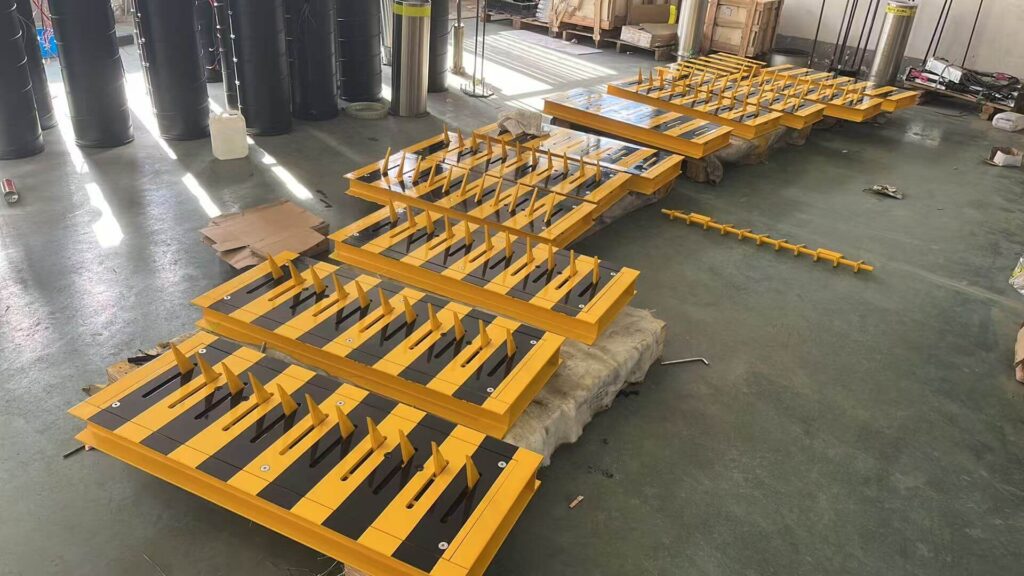
- Tire Killers: Devices equipped with sharp metal spikes or blades designed to puncture and shred the tires of unauthorized vehicles, effectively immobilizing them [4].
While all these systems contribute to anti-ram protection, their operational mechanisms and suitability for different threat scenarios vary significantly. The selection of an appropriate barrier system hinges on a thorough threat assessment, site-specific requirements, and desired operational outcomes.
Tire Killers: Precision Disablement in Perimeter Security
Tire killers are specialized active security devices engineered for the precise disablement of vehicle mobility. Their primary function is to prevent unauthorized vehicle ingress or egress by rendering the vehicle inoperable through tire damage. This approach differs fundamentally from road blockers, which aim for an immediate dead stop. Instead, tire killers focus on removing the vehicle’s ability to maintain controlled movement or high-speed navigation, thereby allowing security personnel time to react and contain the threat [4].
Engineering Principles and Operational Mechanics
The core engineering of a tire killer revolves around a series of high-strength steel spikes or blades, strategically positioned to engage and incapacitate vehicle tires. These spikes are typically angled to maximize penetration and tire shredding upon impact. When an unauthorized vehicle attempts to traverse a raised tire killer, the sharp tips pierce the rubber, leading to rapid air loss. Many professional-grade spikes are designed with hollow or V-shaped profiles to accelerate air discharge, ensuring the tire loses structural integrity quickly. In more robust models, the spikes are long enough to engage with the vehicle’s undercarriage or axle, providing an additional layer of mechanical resistance and further immobilizing the vehicle [5].
Types of Tire Killers: Tailoring Solutions to Specific Needs
Tire killers can be categorized based on their functional mechanisms and installation methods, offering versatility to meet diverse security requirements:
By Function:
- Mechanical Tire Killers: These devices operate on a counterweight load-balancing principle. By default, their spikes are angled upwards. Vehicles moving in the authorized direction depress the spikes, which then return to their original position. However, vehicles approaching from the unauthorized direction encounter the raised spikes, leading to tire puncture. They are cost-effective, easy to install, and ideal for controlling one-way traffic flow without manual or electronic intervention [1].
- Manual Tire Killers: Operated by security personnel via a lever or electronic control, these are discreet, fast-deploying, and highly effective. They are suitable for smaller establishments with less vehicular traffic where human oversight is readily available [1].
- Automatic Tire Killers: These are technologically advanced systems that can be programmed for autonomous operation, often integrated with motion sensors or other triggers. They seamlessly interface with other security equipment such as video cameras, road blockers, and Under Vehicle Surveillance Systems (UVSS), providing rapid response times for high-security infrastructures [1].
By Installation:
- Underground (In-Ground) Tire Killers: Embedded within the road surface, these systems are flush with the ground, offering a discreet and aesthetically pleasing solution. They are particularly useful in locations where visual impact is a concern and permanent fixtures are desired [1].
- Above-Ground (Surface-Mounted) Tire Killers: Installed directly on the road surface, these are easier to install and uninstall compared to underground variants, making them suitable for temporary deployments or locations where excavation is impractical. Their visible presence also serves as an active deterrent [1].
Advantages of Integrating Tire Killers into Security Systems
The strategic deployment of tire killers offers several distinct advantages, making them a valuable asset in a comprehensive security strategy:
- Effective Immobilization: Tire killers are highly effective at quickly deflating vehicle tires, immobilizing unauthorized vehicles and providing security personnel with crucial time to respond and neutralize a threat [1].
- Durability and Longevity: Designed for outdoor installation, these barriers are constructed from robust, long-lasting materials, often treated with anti-corrosive coatings to ensure extended operational life and minimal degradation in harsh environments [1].
- Seamless Integrability: Modern tire killers are designed for easy integration with existing security infrastructures. They can be paired with other perimeter protection equipment, such as road blockers, boom barriers, and access control systems, to create a cohesive and highly efficient security network [1] [5].
- Versatility and Customization: Available in various types and configurations, tire killers can be adapted to different site conditions, road widths, and specific security needs. Customization options allow for tailored solutions that fit unique operational and aesthetic requirements [1].
- Deterrence: The visible presence of tire killers, particularly above-ground models, acts as a powerful visual deterrent, discouraging potential intruders from attempting unauthorized entry [1].
- Gestion du trafic: Mechanical tire killers, in particular, are excellent for enforcing one-way traffic flow, preventing vehicles from entering restricted areas from the wrong direction without impeding authorized movement [1] [6].
- Lower Total Cost of Ownership (TCO): Compared to crash-rated road blockers, tire killers often have a lower TCO due to simpler installation requirements and potentially lower power consumption, especially for mechanical or manual variants [5].
Tire Killers vs. Traditional Road Blockers: A Technical Divide
While both tire killers and traditional road blockers are critical components of anti-ram protection, their fundamental operational philosophies and impact resistance capabilities differ significantly. Understanding these distinctions is crucial for selecting the appropriate system for a given threat profile and operational context.
Kinetic Energy and Crash Ratings
The most significant technical divergence lies in their response to kinetic energy and their associated crash ratings. Traditional road blockers are frequently designed and tested to meet stringent professional security standards such as PAS 68 (UK), IWA 14-1 (International), and ASTM F2656 (US). These certifications validate a blocker’s ability to stop a specific vehicle weight traveling at a defined speed with minimal penetration. For instance, an M50 rated road blocker is certified to halt a 7,500kg truck moving at 80km/h (50mph) [5]. The engineering behind these systems involves substantial foundation reinforcement and high-tensile steel alloys to absorb and dissipate massive amounts of kinetic energy into the surrounding civil works [5].
Tire killers, conversely, are generally not crash-rated in the same manner. While exceptionally effective at eventually stopping a vehicle, they do not provide an immediate “dead stop” for a heavy vehicle traveling at high speed. A vehicle with shredded tires may still travel a considerable distance due to its existing momentum [5]. However, this lack of a crash rating does not render tire killers inferior; rather, it highlights their specialized role. In scenarios where the primary threat is unauthorized entry or “wrong-way” travel, rather than a high-speed ramming attack, tire killers offer a highly efficient and often more cost-effective solution [5].
Operational Considerations: Speed and Civil Engineering
Deployment speed is a critical factor in active security systems. Due to the lower mass of the spike assembly, tire killers can often be raised or lowered in 1.0 to 2.0 seconds, making them ideal for high-traffic areas where throughput is a priority [5]. Road blockers, moving a much larger mass, typically require 3.0 to 5.0 seconds for standard deployment, although high-security models may feature Emergency Fast Raise (EFR) systems [5].
Civil engineering requirements also present a significant differentiator. Crash-rated road blockers necessitate massive concrete pits, involving extensive excavation, steel reinforcement, and specialized drainage systems. This can be prohibitive in urban environments with dense underground utilities [5]. Tire killers, available in surface-mount or shallow-mount configurations, require significantly less civil work, making them a viable option where deep excavation is impossible or undesirable [5].
Strategic Deployment: The “Defense in Depth” Approach
Professional security design is predicated on the principle of “Defense in Depth,” which involves layering multiple security measures to create a robust and resilient protective posture. Understanding where tire killers fit within this architecture is key to maximizing their effectiveness.
Ideal Use Cases for Tire Killers
Tire killers are particularly well-suited for specific operational scenarios:
- Directional Control: Enforcing one-way traffic in car parks, rental car returns, or access roads, preventing “wrong-way” entry [5] [6].
- Medium-Security Checkpoints: Deterring unauthorized vehicles at residential compounds, industrial warehouses, or commercial office parks where the threat of a high-speed ramming attack is low [5].
- Space-Constrained Sites: Providing effective vehicle disablement in locations where deep excavation for a road blocker is not feasible [5].
The Interlocking “Air-Lock” Strategy
A sophisticated security solution often combines tire killers with other barrier systems to create an interlocking “Air-Lock” configuration. This strategy typically involves:
- A Boom Barrier (Arm Gate): Handling routine traffic management and initial access control.
- A Tire Killer or Road Blocker: Remaining in the raised position as the “hard” enforcement mechanism.
- System Logic: Ensuring the hard barrier only lowers after the vehicle has been cleared by security and the boom barrier has opened.
This configuration prevents accidental damage to authorized vehicles while ensuring a robust defense against intruders, effectively mitigating the risk of tailgating or forced entry [5].
The Professional Viewpoint: Quality and Future Trends
When evaluating tire killers, security professionals must look beyond the surface to assess the underlying quality and engineering. The spikes should be manufactured from high-tensile carbon steel or stainless steel, with sufficient thickness and heat treatment to prevent bending or shearing under heavy loads [5]. Furthermore, modern tire killers must integrate seamlessly with advanced technologies such as Automatic Number Plate Recognition (ANPR), loop detectors, and Programmable Logic Controllers (PLCs) to enable sophisticated operational logic and enhanced safety features [5].
Looking ahead, the industry is moving towards IoT-enabled perimeter security. Future tire killers will likely feature remote diagnostics, real-time monitoring of operational parameters, and predictive maintenance algorithms, further enhancing their reliability and integration within smart security ecosystems [5].
Conclusion
Tire killers are not merely punitive devices; they are sophisticated, engineered solutions that play a vital role in modern anti-ram protection and perimeter security design. By offering precise vehicle disablement, rapid deployment, and versatile integration capabilities, they provide a highly effective means of controlling access and mitigating vehicular threats. While they differ fundamentally from crash-rated road blockers in their approach to kinetic energy neutralization, their strategic deployment—particularly within a layered “Defense in Depth” architecture—significantly enhances the overall security posture of any facility. For security architects and facility managers, understanding the technical nuances and operational strengths of tire killers is essential for designing comprehensive and resilient security systems that effectively safeguard critical assets and personnel.