Введение
For many years, hydraulic rising bollards were the default choice when a site needed controlled vehicle access. The logic was straightforward: hydraulic power could move a heavy steel post quickly, tolerate frequent operation and provide substantial force. At demanding entrances, that combination remains valuable.
Yet the centre of gravity in the market is moving. More new installations, particularly in urban, residential, commercial and retrofit environments, are being specified around wireless control, electromechanical drives and battery-supported power. This is not because hydraulic bollards have suddenly become obsolete. It is because the problems that now matter most are often different from those that shaped earlier projects: disruption to existing paving, access to mains power, noise, drainage, maintenance skills, system integration and the ability to change a site after installation.
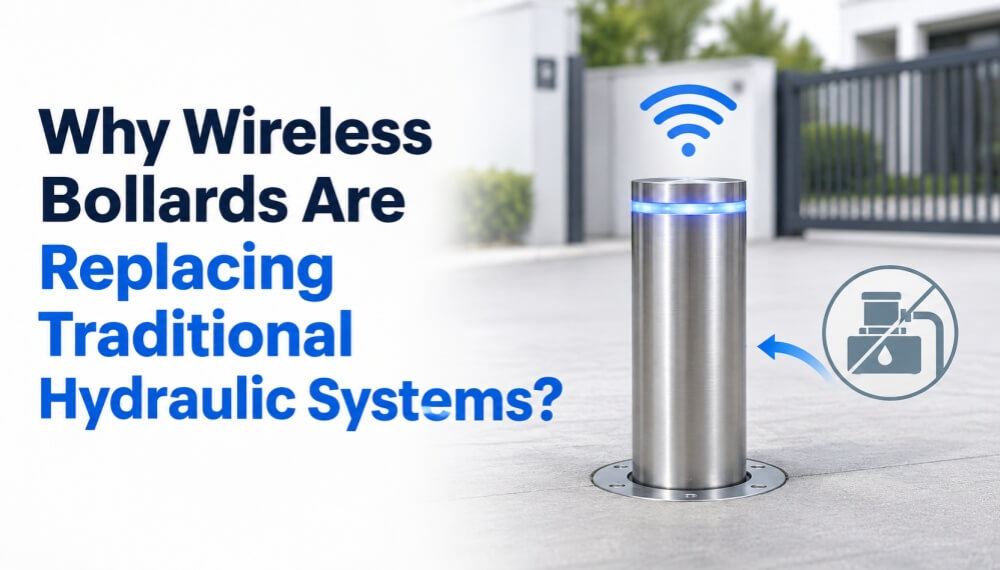
The word “wireless” also needs to be used carefully. A wireless бульварный столбик is not necessarily a completely cable-free security device, and wireless control does not automatically mean that the lifting mechanism is electromechanical . In practice, the term may describe radio or app-based commands, battery operation, wireless communication between access-control devices, or a combination of these features. The most important shift is therefore architectural: fewer fixed dependencies between the bollard, a remote hydraulic power unit, underground cabling and the access-control system.
This article examines why that architecture is becoming more common, where it offers a genuine advantage, and where traditional hydraulic systems still deserve serious consideration.

Installation has become the decisive advantage
The clearest reason for the move toward wireless systems is the amount of civil work they can remove. A conventional hydraulic installation normally needs more than a hole for each bollard. Depending on the design, it may require a pump unit, reservoir, pressure lines, control wiring, drainage, service access and a protected route between the bollard and the hydraulic power unit. The work can be straightforward on a new site, but it becomes much more complicated when the surface is already paved, landscaped or occupied.
Wireless systems change that calculation. If the bollard is battery-powered and controlled by a secure radio link, there may be no need to cut a long trench for power and signal cables. If each bollard contains its own drive unit, there is also no hydraulic hose connecting it to a separate pump cabinet. The installation still requires a properly engineered foundation, water management and electrical commissioning where applicable, but the dependency on long underground routes is reduced.
That matters in historic districts, renovated buildings, public plazas and occupied facilities. A project can be delayed by the discovery of an existing utility, a reinforced slab, a drainage problem or a prohibition on visible cable routes. The less infrastructure that must be coordinated below ground, the more predictable the installation becomes. It can also reduce the period during which pedestrian and vehicle circulation is interrupted.
However, “no trenching” should not be treated as “no groundwork.” A rising bollard still transfers loads into the ground. The foundation must accommodate the dimensions of the sleeve, the anticipated traffic and the local drainage conditions. A wireless product that is installed without adequate water management or without a clear maintenance method may simply exchange one problem for another.
Wireless systems suit retrofit projects and changing sites
Traditional hydraulic systems are most economical when the entire access lane is designed around them from the beginning. Their power unit, pipe routes and control cabinet can be coordinated with the structure, and the site can provide the drainage and electrical capacity they require. Existing sites are less forgiving.
Many modern access points are not permanent in the way they used to be. A pedestrian street may close to vehicles only during certain hours. A loading area may change its operating pattern. A property may add a new entrance-control system, rearrange its parking layout or temporarily protect an event space. Wireless bollards are attractive in these situations because the control layer is easier to modify and the physical installation is less tightly bound to one fixed arrangement.
This flexibility is particularly useful where access permissions change more often than the hardware. A remote transmitter, card reader, intercom, automatic number-plate recognition system or mobile application can issue the command, while the bollard remains in place. A well-designed system can also allow several control methods to coexist, with different permissions for security staff, residents, service vehicles and emergency responders.
The advantage is not merely convenience. It reduces the risk that a change in access policy will require a new control cabinet or a new underground cable route. It also makes staged installation more practical. A site can begin with a small number of controlled points and expand later, provided the radio network, power budget and safety logic were designed for that growth.
Electromechanical drives remove an entire maintenance category
Hydraulic and electromechanical bollards fail in different ways because their drive systems contain different kinds of energy and different wear components. A hydraulic unit uses a pump to pressurise fluid, valves to direct it and a cylinder to move the post. The system may also include hoses, seals, a reservoir, filters and pressure controls. These parts are mature and well understood, but they create a maintenance regime that cannot be ignored.
Hydraulic service can involve fluid analysis or replacement, filtration checks, seal inspections, hose inspection, pressure testing, environmental review and functional safety tests. Industry maintenance guidance commonly lists these tasks as part of keeping retractable hydraulic barriers operational. A small leak may first appear as a slow movement or a damp area, but it can become a performance and environmental problem if it is not addressed.
An electromechanical bollard uses a motor and a mechanical transmission, such as a screw, gear or chain arrangement. There is no hydraulic reservoir, no pressure hose and no oil circuit. That does not make it maintenance-free. Bearings, gears, lead screws, limit switches, seals and the motor itself still require inspection. Dirt, corrosion, impact damage and water ingress remain important concerns. The difference is that the maintenance is usually more familiar to a general electrical or mechanical service team and does not involve hydraulic fluid management.
For many sites, this is a meaningful reduction in operational complexity. The system has fewer components distributed across the site, fewer concealed connections and fewer failure modes related to fluid loss. It can also make troubleshooting more direct: a technician can inspect power, control signals, position feedback and mechanical movement without first diagnosing pressure stability.
The engineering conclusion should still be specific to the duty cycle. A lightly used entrance and a high-frequency service lane should not be assessed by the same maintenance assumptions. Electromechanical equipment must be selected with a rated cycle frequency, thermal limits and environmental protection appropriate to the application.
Low-voltage power makes safety and backup easier
Many contemporary electromechanical bollards operate from low-voltage DC power rather than the higher-voltage, three-phase supply often associated with heavy hydraulic equipment. This does not remove the need for proper electrical design, but it can simplify the relationship between the bollard, the control cabinet and the backup battery.
A low-voltage system is easier to pair with a battery bank, solar-assisted charging or an uninterruptible power supply. During a short power interruption, the bollard may continue to operate without starting a generator. In locations where mains power is unreliable or unavailable, a battery-supported design can be more practical than extending a dedicated supply to every access point.
The benefit is especially visible when the bollards are distributed across a wide site. With a hydraulic arrangement, the power unit may remain central, but the hydraulic lines and control wiring still need to reach each bollard. With a self-contained wireless unit, the designer can focus on battery capacity, recharge strategy and communications reliability instead.
Battery power introduces its own obligations. Battery life depends on cycle frequency, temperature, standby consumption and charging efficiency. A site that expects hundreds of operations per day cannot use the same battery assumptions as a gate that moves a few times each week. A responsible specification should identify expected autonomy, low-battery warnings, charging intervals, replacement access and the behaviour of the bollard when the battery reaches its reserve threshold.
In other words, wireless power is not free power. It shifts the maintenance question from hydraulic fluid and pressure to energy management and battery condition. For the right site, that is a favourable trade. For a high-cycle, unattended entrance with no practical charging plan, it may not be.

Quieter operation matters in populated areas
Hydraulic pumps produce a distinctive sound each time the system operates. Noise is rarely the first consideration in a security specification, but it becomes important when the bollard is beside a hotel entrance, hospital, apartment building, school, café or pedestrian plaza. Repeated operation can make a technically successful system unpopular with the people who live or work nearby.
Electromechanical systems generally produce a lower and less intrusive sound profile. Wireless control can also reduce the need for a large remote pump unit close to a building façade or public walkway. The result is not silent operation; motors, gears and moving steel still generate noise. But the character and duration of the sound are often easier to accept in a mixed-use environment.
Noise should be verified rather than promised. The acoustic result depends on the motor, transmission, foundation, cover, speed profile and surrounding surfaces. A poorly installed electromechanical bollard can vibrate, while a well-designed hydraulic unit can be acceptably quiet. The point is that wireless electromechanical architecture gives the designer more options when acoustic disturbance is a constraint.
Integration is becoming more important than the actuator
A modern bollard is rarely operated only by a simple push button. It may be connected to an access-control panel, card reader, intercom, loop detector, camera, automatic number-plate recognition system or building-management platform. Wireless technology makes the communication layer more adaptable, especially where the access-control equipment is already digital.
This does not mean that every device should be connected to the internet. In security applications, a local and encrypted radio link may be more appropriate than a cloud-dependent command path. The system should define who can issue a raise or lower command, how devices are authenticated, how lost transmitters are revoked and what happens if communication is interrupted.
Cybersecurity and physical safety are connected. An unauthorised command is a security failure, but a delayed or duplicated command can also create a collision risk. A sound design includes command acknowledgement, obstacle detection, visual warning, event logging and an emergency override. The wireless link should be treated as one layer in a safety architecture, not as a substitute for sensors and operating procedures.
Integration also has a practical benefit. When access permissions change, software configuration can often be updated without replacing the mechanical barrier. This is one reason wireless systems appeal to sites that expect their access rules to evolve.
Wireless does not automatically mean higher security
The most important qualification is that wireless convenience and vehicle-impact performance are separate questions. A bollard can be wireless and still be unsuitable for a hostile-vehicle mitigation application. Conversely, a hydraulic bollard can be the correct choice when a heavy post, rapid movement and a certified crash rating are required.
Vehicle security barriers should be evaluated using a relevant test standard and a complete installed system . ISO IWA 14-1, for example, specifies impact performance requirements and a test method for vehicle security barriers. ASTM F2656 is another recognised crash-testing method for perimeter barriers. These standards are not a decorative label: the vehicle mass, speed, penetration distance, foundation, spacing and installation details all affect the result.
A common mistake is to compare motors instead of tested systems. A powerful actuator does not by itself prove that the post, sleeve, foundation and surrounding pavement will withstand an impact. The same caution applies to claims about “anti-terror” or “crash-rated” performance. The rating should be tied to test evidence, the exact model and the installation conditions.
Hydraulic systems often remain strong candidates for very heavy, high-security bollards and entrances with extremely high cycle counts. Their force density and established performance can outweigh their installation and maintenance burden. Electromechanical systems are improving, but they should not be selected for an impact requirement merely because they are easier to install.

Weather and drainage still determine reliability
Wireless operation does not eliminate environmental exposure. The bollard remains in the ground, where water, mud, salt, grit, freeze–thaw cycles and vehicle chemicals can attack the housing and moving parts. A wireless system with a sealed drive and suitable ingress protection may reduce the need for a dedicated hydraulic drainage arrangement, but it still needs a foundation designed for the local ground conditions.
Cold weather deserves particular attention. Hydraulic fluid can become more viscous at low temperature, affecting speed and response. Battery capacity can also fall in cold conditions, and radio performance can be affected by the placement of antennas and metal structures. Coastal locations add salt exposure; flood-prone sites add hydrostatic and contamination risks.
A credible specification should therefore state the operating temperature range, ingress-protection level, corrosion-resistant materials, drainage approach, battery behaviour and emergency procedure. Stainless steel grade, coating system and seal design may be more important to service life than the word “wireless” on the product label.
Failure behaviour should be part of the design decision
The best drive system is not the one that looks simplest on paper. It is the one whose failure behaviour matches the consequences of failure at the site.
A hydraulic failure may involve a pump fault, pressure loss, valve issue or hose rupture. The bollard can stop in a raised, lowered or intermediate position. An electromechanical system may show gradual wear in a gear, screw or motor before it stops, although an electronic fault or depleted battery can also cause an abrupt loss of operation. A wireless system adds the possibility of communication loss, interference or a damaged transmitter.
The design response is to define safe states before installation. Should the bollard remain raised to protect the perimeter, or lower to preserve emergency access? Is manual release possible? Can firefighters or security staff operate the mechanism without specialist tools? Is there a local wired override even when normal commands are wireless? How are obstruction events handled?
These questions are more valuable than a generic claim that one technology is “more reliable.” Reliability is not only the probability of a fault. It is also the predictability of the fault, the warning available before it occurs, the time required to restore operation and the consequences for people and vehicles.
The replacement is selective, not universal
Wireless bollards are replacing traditional hydraulic systems most quickly where the project values reduced civil work, quiet operation, flexible access control and simpler routine maintenance. Typical examples include residential entrances, car parks, campuses, delivery areas, pedestrian zones and retrofit projects where mains power or cable routes are inconvenient.
Hydraulic systems remain relevant where the priority is maximum force, very heavy high-security cylinders, demanding cycle rates or an established hydraulic maintenance capability. They may also be the sensible choice when a new site already has a suitable power unit, drainage and service infrastructure. Replacing a functioning hydraulic arrangement purely because wireless technology is fashionable would be poor engineering.
The more useful question is not “Which technology is newest?” It is “Which dependencies create the most risk for this site?” If trenching is the major risk, wireless may help. If hydraulic maintenance is the major risk, electromechanical may help. If impact certification is the major risk, the tested security rating should lead the decision. If emergency access is critical, the power-failure and manual-release strategy should be evaluated before the control interface.
Заключение
Wireless булы are gaining ground because they align with the way many sites are now built and managed. They reduce dependence on fixed cable routes and remote hydraulic equipment. They can simplify retrofits, support low-voltage backup power, reduce noise and integrate more naturally with modern access-control systems. Electromechanical drives also remove the fluid, hoses and pressure checks associated with hydraulic maintenance.
But wireless is not a universal replacement for hydraulic power. It does not remove foundation engineering, battery planning, environmental protection, safety controls or the need for independent crash-performance evidence. The strongest specification is not the one with the most advanced interface. It is the one that matches the drive system, power architecture, control method, safety response and security rating to the actual site.
The market is therefore moving toward wireless bollards for practical reasons rather than technological fashion. In many everyday access-control applications, a compact, low-maintenance and adaptable system now offers a better balance than a hydraulic installation. In the most demanding security environments, hydraulic systems will continue to earn their place. The future is not hydraulic versus wireless in absolute terms; it is more careful selection of where each architecture creates the least operational risk.