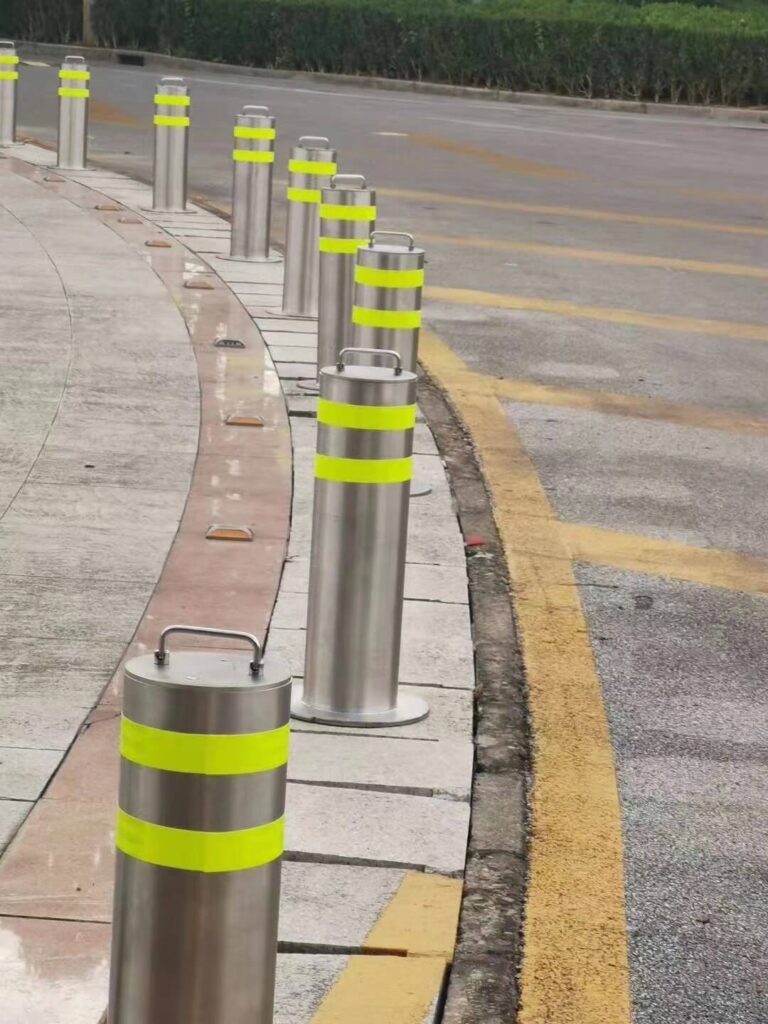

Introduction
In the landscape of modern urban planning and facility management, the “bollard” has evolved from a simple physical post into a sophisticated piece of security infrastructure. Whether it is protecting a high-profile government building, managing traffic in a busy commercial plaza, or securing a private estate, the choice of bollard system is no longer just about the diameter of the steel pipe or the aesthetic finish. Today, the most critical decision lies beneath the surface: the drive mechanism.
For decades, hydraulic systems were the undisputed gold standard for heavy-duty, high-security applications. However, the rapid advancement of electro-mechanical technology—specifically battery-powered wireless systems—has challenged this status quo. This shift represents more than just a change in power source; it reflects a broader industry movement toward decentralization, sustainability, and reduced lifecycle costs.
For project managers, architects, and security consultants, the choice between battery-powered and hydraulic bollards involves a complex trade-off between raw power, installation flexibility, and long-term maintenance. This article provides a comprehensive technical comparison to help you determine which system aligns with the specific requirements of your project.
Hydraulic Bollards – The Traditional Heavyweight
The Mechanics of Hydraulic Systems
Hydraulic bollards operate on the principle of fluid power. A central or integrated hydraulic power unit (HPU) uses an electric motor to drive a pump, which pressurizes hydraulic fluid. This fluid is then directed through hoses to a cylinder inside the bollard, pushing the piston to raise or lower the post.
Strengths: Why They Dominate High-Security
- **Unmatched Power-to-Size Ratio**: Hydraulics are capable of generating immense force. For very large, heavy-duty bollards (e.g., those designed to stop a 7.5-ton truck at 80 km/h), hydraulic systems provide the necessary torque to move massive steel components quickly and reliably.
- **High-Frequency Operation**: In environments like toll booths or busy logistics hubs where bollards might cycle hundreds of times a day, hydraulic systems have a long-standing track record of durability under heavy duty cycles.
- **Centralized Control**: In large-scale installations, multiple bollards can be driven by a single large HPU located in a secure, remote room. This simplifies some aspects of electronic control but complicates the physical infrastructure.
The Challenges: The “Hidden” Costs of Hydraulics
While powerful, hydraulic systems come with significant logistical and environmental burdens:
- **Complex Installation**: Installing a hydraulic system requires not just the bollard pit, but also extensive trenching for hydraulic lines and the construction of a separate housing for the HPU.
- **Maintenance Intensity**: Hydraulic fluid must be monitored for contamination, filters must be replaced, and seals eventually leak. In cold climates, the viscosity of the fluid changes, often requiring heaters to ensure consistent operation.
- **Environmental Risks**: A single ruptured hose can leak liters of petroleum-based fluid into the soil, leading to expensive environmental remediation and regulatory hurdles.

Battery-Powered Bollards – The Wireless Revolution
The Shift to Electro-Mechanical Autonomy
Battery-powered bollards represent the latest evolution of electro-mechanical drive systems. Unlike traditional electric bollards that require constant mains power via underground cabling, battery-powered models utilize high-capacity lithium-ion batteries to drive a high-efficiency DC motor and screw-jack mechanism.
The Advantages: Flexibility and Resilience
- **Zero-Trenching Installation**: The most significant advantage is the elimination of the “umbilical cord.” Because the power source is internal, there is no need for extensive trenching across existing roads or sidewalks. This can reduce installation time from days to hours and cut civil engineering costs by up to 60%.
- **Operational Continuity**: Traditional bollards are vulnerable to power outages. While some have UPS backups, a battery-powered bollard is inherently “off-grid.” It will continue to function perfectly even if the facility’s main power is cut—a critical feature for security during emergencies.
- **Minimal Maintenance**: Modern electro-mechanical drives are largely “sealed-for-life.” There are no fluids to change, no hoses to check, and no pumps to service. The primary maintenance task is a simple battery health check or replacement every few years.
The Trade-offs: What to Consider
- **Charging Cycles**: While a single charge can last for hundreds of cycles (often months of typical use), they are not suited for ultra-high-frequency applications (e.g., 500+ cycles per day) unless integrated with a solar charging system.
- **Initial Battery Cost**: High-quality lithium batteries add to the upfront hardware cost, though this is usually offset by the savings in installation and maintenance.
Technical Comparison Matrix
To better understand how these two systems compare in a real-world project environment, we can look at several key performance indicators (KPIs).
| Feature | Hydraulic Bollards | Battery-Powered Bollards |
| **Drive Type** | Fluid Pressure / Cylinder | DC Motor / Mechanical Screw |
| **Installation** | High Complexity (Trenching + HPU) | Low Complexity (Self-contained) |
| **Power Source** | Mains Electricity (Centralized) | Internal Battery (Autonomous) |
| **Maintenance** | High (Fluid, Seals, Hoses) | Very Low (Battery, Lubrication) |
| **Environmental Impact** | Potential Fluid Leaks | Eco-friendly / Solar compatible |
| **Operating Temp** | Sensitive (Fluid Viscosity) | Stable (Insulated Battery) |
| **Response Speed** | 3-6 Seconds | 4-8 Seconds |
| **Reliability in Outage** | Requires External UPS | Built-in Autonomy |
| **Lifecycle Cost (10yr)** | High (due to maintenance) | Low (due to simplicity) |
Deep Dive – Total Cost of Ownership (TCO)
In B2B project procurement, the “sticker price” of the bollard is often misleading. A professional analysis must look at the Total Cost of Ownership over a 10-year horizon.
The Hydraulic TCO Curve
A hydraulic system starts with a moderate equipment cost but a very high installation cost. Over time, the cost curve rises steeply due to scheduled maintenance (fluid changes every 24 months) and unscheduled repairs (seal leaks, pump failures). Furthermore, the energy consumption of a large HPU, which often stays pressurized or on standby, adds a consistent operational expense.
The Battery-Powered TCO Curve
Conversely, battery-powered bollards have a higher initial equipment cost due to the battery technology and sophisticated motor controllers. However, the installation cost is a fraction of the hydraulic alternative. The maintenance curve remains almost flat for the first 5-7 years, with only a small spike when the battery reaches the end of its service life and requires replacement.
Professional Insight: For projects involving more than 5 bollards spread across a large site, the savings on copper cabling and trenching alone often make the battery-powered option the more financially sound choice before the first day of operation.

Environmental and Climate Considerations
The Cold Weather Challenge
One of the most common debates in bollard selection is performance in extreme temperatures.
- **Hydraulic**: In sub-zero temperatures, hydraulic oil thickens. This slows down the bollard’s response time and puts immense strain on the pump. While “low-temp” fluids exist, they are expensive and still require the system to run more frequently to stay warm.
- **Battery/Electric**: Modern lithium-ion batteries used in industrial bollards are often equipped with internal thermal management. Furthermore, mechanical gear drives are less affected by temperature-induced viscosity changes than fluid systems, making them more reliable in regions like Northern Europe, Canada, or Northern China.
Sustainability and “Green” Building Standards
As more projects aim for LEED or similar green certifications, the environmental footprint of security hardware is being scrutinized. Hydraulic systems, with their risk of soil contamination and higher energy draw, are increasingly viewed as a liability. Battery-powered systems, especially when paired with small solar arrays for trickle-charging, represent a “zero-emission” security solution that aligns with modern ESG (Environmental, Social, and Governance) goals.
Security and Impact Resistance – The “Power” Myth
There is a persistent myth that only hydraulic bollards can achieve high crash ratings (e.g., K12, M50, or IWA 14-1). While this was true 15 years ago, it is no longer the case.
The crash rating of a bollard is primarily a function of its structural engineering—the depth of the foundation, the grade of the steel, and the internal reinforcement—not the drive mechanism. Once a bollard is in the “up” position, a mechanical self-locking screw (used in battery/electric models) is often more rigid than a hydraulic column, which relies on valve seals to maintain pressure during an impact.
Today, leading manufacturers offer battery-powered bollards that are fully certified to stop heavy vehicles at high speeds. The “power” of the drive system only determines how fast the bollard rises, not how much force it can withstand upon impact.
Application Analysis – Which One for Your Project?
Choose Hydraulic Bollards IF:
- **Ultra-High Frequency**: You are managing a site with constant vehicle throughput (e.g., more than 50 cycles per hour, 24/7).
- **Existing Infrastructure**: You are replacing old hydraulic bollards and the trenching/HPU housing is already in place.
- **Extreme Weight**: You require exceptionally large diameter bollards (300mm+) where mechanical screw drives might be too slow.
Choose Battery-Powered Bollards IF:
- **Retrofit Projects**: You are adding security to an existing facility where digging up the road for cables/hoses would be too disruptive or expensive.
- **Remote or Off-Grid Sites**: Locations where bringing mains power is difficult or impossible.
- **Sustainability Focus**: Projects aiming for low environmental impact and minimal energy consumption.
4. Critical Security: Sites where the bollards MUST work during a total power failure without relying on complex external generators.
5. Multi-Point Distribution: Large sites where bollards are placed far apart, making centralized hydraulics impractical.
The Future – IoT and Smart Integration
The next frontier for bollards is not how they move, but how they communicate. Battery-powered systems are leading this charge. Because they already incorporate sophisticated electronic controllers to manage battery health, they are easily integrated into “Smart City” networks.
A modern battery-powered bollard can:
- Report its battery status and “health” to a central dashboard via LoRaWAN or 5G.
- Be controlled via a smartphone app or encrypted remote.
- Automatically lower in the presence of an emergency vehicle’s siren (using acoustic sensors).
This level of intelligence is much harder to implement in “dumb” hydraulic systems, which typically rely on basic limit switches and centralized PLCs.
Conclusion: Making the Professional Choice
The decision between battery-powered and hydraulic bollards is a classic case of “traditional reliability” versus “modern efficiency.” While hydraulic systems will always have a place in specialized, ultra-heavy-duty applications, the trend is clear: the future of perimeter security is autonomous, electric, and decentralized.
For the majority of modern B2B projects—from corporate headquarters to public parks—battery-powered bollards offer a compelling combination of lower total cost, easier installation, and superior environmental performance. By removing the complexities of hydraulic plumbing and mains wiring, they allow security professionals to focus on what matters most: protecting people and assets with precision and reliability.
Real-World Case Scenarios: A Comparative Analysis
To further illustrate the practical implications of these technologies, let us examine two hypothetical but highly representative project scenarios where the choice of drive mechanism significantly impacted the project outcome.
Scenario A: The Historic City Center Retrofit
A European city sought to pedestrianize its historic market square. The project faced strict regulations regarding archaeological preservation, meaning deep trenching for power and hydraulic lines was strictly prohibited.
- **The Solution**: The project team selected battery-powered wireless bollards.
- **The Result**: Because the bollards only required a single shallow excavation for the foundation, the installation was completed without disturbing any historical artifacts. The bollards were integrated with a local LoRaWAN network for remote management by the city’s traffic department. The lack of external wiring meant the city saved approximately $120,000 in specialized excavation and restoration costs.
Scenario B: The High-Throughput Logistics Hub
A global shipping company required a vehicle access control system for its main distribution center, where heavy trucks enter and exit every 90 seconds, 24 hours a day.
- **The Solution**: Given the extreme duty cycle (over 900 cycles per day), a high-performance hydraulic system was chosen.
- **The Result**: The hydraulic system provided the necessary durability for constant operation. While the installation was complex and expensive, the system’s ability to handle the relentless mechanical stress of near-continuous lifting was the deciding factor. However, the company had to sign a comprehensive maintenance contract to ensure that any hydraulic leaks were addressed within hours to prevent operational downtime.
Frequently Asked Questions (FAQ) for Project Managers
1. Can battery-powered bollards be integrated with existing access control systems?
Yes. Modern battery-powered bollards use standard wireless protocols (such as Zigbee, Bluetooth, or cellular) to communicate with central security consoles. They can be triggered by RFID readers, license plate recognition (LPR) cameras, or manual remote controls just like wired systems.
2. What happens if the battery dies while the bollard is in the “up” position?
Most professional-grade battery-powered bollards are designed with a “fail-secure” or “manual override” mechanism. If the battery drops below a critical threshold, the system can send an alert to the operator. In the event of total power loss, a manual key can be used to lower the bollard for emergency vehicle access.
3. Are hydraulic bollards better for cold climates?
Actually, the opposite is often true. Hydraulic fluid is highly sensitive to temperature. While heaters can be installed, they increase the complexity and energy consumption of the system. Battery-powered models with insulated compartments and mechanical gear drives often perform more consistently in extreme cold.
4. How long does a typical battery last?
In a standard commercial application (e.g., 10-20 cycles per day), a high-capacity lithium battery can last between 12 to 24 months on a single charge. The overall lifespan of the battery pack itself is typically 5 to 8 years before it needs replacement.

Strategic Procurement – Asking the Right Questions to Manufacturers
When evaluating suppliers for your bollard project, it is essential to look beyond the basic specifications. Here are five critical questions every procurement professional should ask:
- **What is the “Duty Cycle” rating?** Ensure the drive system can handle your expected traffic volume without overheating or premature wear.
- **What is the IP (Ingress Protection) rating of the drive unit?** For underground installations, look for IP67 or IP68 to ensure the motor or hydraulic pump is protected from groundwater.
- **Is the system “Plug-and-Play”?** For battery systems, ask if the controller and battery are integrated into the bollard unit or require a separate cabinet.
4. What is the documented TCO over 10 years? Ask for a breakdown of expected maintenance costs, including fluid changes, seal replacements, or battery swaps.
5. What certifications do you hold? Beyond crash ratings, look for ISO certifications for manufacturing quality and CE/UL ratings for electrical components.
When selecting your next system, look beyond the initial quote. Consider the ground conditions, the cost of the trenching, the reality of long-term maintenance, and the need for operational continuity. In the modern world, the most powerful security solution is often the one that doesn’t need a cord.
About the Author / Expert Perspective
As a leading manufacturer in the bollard industry, we have seen the transition from pure mechanical barriers to integrated security systems. Our perspective is rooted in the belief that high-quality manufacturing combined with innovative power solutions is the only way to meet the rigorous demands of global infrastructure projects. We prioritize the use of high-grade materials and rigorous testing to ensure that whether you choose hydraulic or battery-powered, your project is secured for the long term.