
Introducción
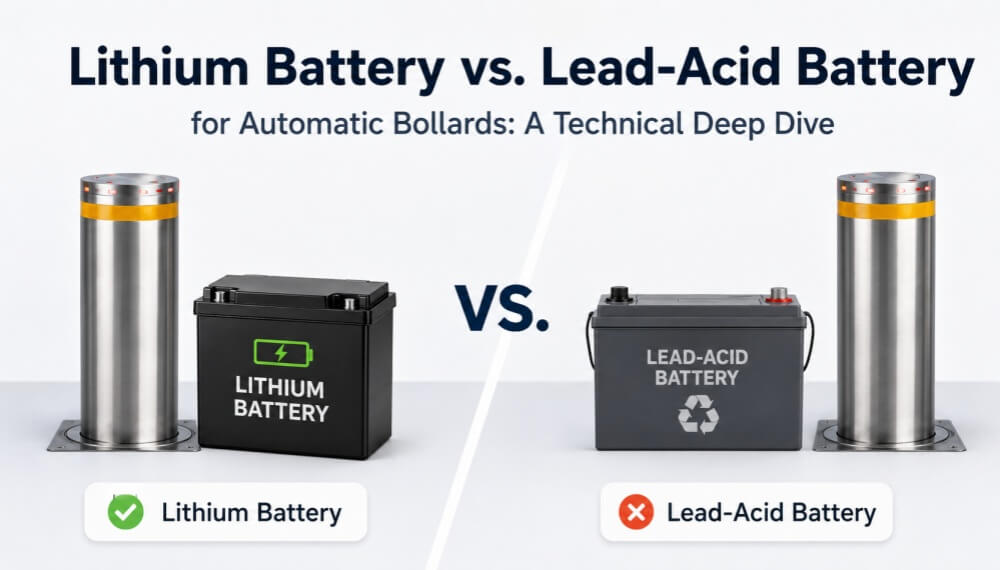
Automatic bollards are indispensable components in modern security and traffic management systems, offering dynamic control over vehicle access. From safeguarding pedestrian zones to securing high-value assets, their reliable operation is paramount. At the heart of many such systems lies the power source, a critical element determining performance, longevity, and overall efficiency. For years, lead-acid batteries have been the conventional choice, a familiar and seemingly cost-effective solution. However, with advancements in battery technology, lithium-ion batteries, particularly Lithium Iron Phosphate (LiFePO4), are rapidly emerging as a superior alternative, challenging the status quo. This article delves into a comprehensive technical comparison of these two battery technologies, evaluating their suitability for automatic bollard applications and offering insights into why the industry is witnessing a significant shift.
Understanding the Demands of Automatic Bollards
Automatic bollards, whether retractable, rising, or removable, operate under specific and often demanding conditions. Their power source must be capable of:
- High Peak Current Delivery: Actuators (electric motors or hydraulic pumps) require substantial bursts of current during activation and retraction cycles, especially under load or in adverse conditions.
- Consistent Voltage Output: Stable voltage is crucial for the optimal performance and longevity of the bollard’s electronic control systems and mechanical components. Voltage sag during operation can lead to sluggish movement, increased wear, and potential system failures.
- Frequent Cycling: Depending on the application, bollards may cycle dozens or even hundreds of times a day. The battery must withstand these charge and discharge cycles without significant degradation.
- Wide Operating Temperature Range: Bollards are often deployed outdoors, exposed to extreme temperatures, from freezing winters to scorching summers. Battery performance and lifespan are heavily influenced by temperature.
- Low Self-Discharge: For bollards in remote locations or those with intermittent use, the battery needs to retain its charge over extended periods.
- Minimal Maintenance: Accessibility for maintenance can be challenging, making low-maintenance solutions highly desirable.
- Long Service Life: Replacing batteries in installed bollards can be disruptive and costly, making a long-lasting power source a key economic factor.

Lead-Acid Batteries: The Traditional Workhorse
Lead-acid batteries have a long history of use in various applications, including automatic bollards, primarily due to their lower initial cost and mature technology. They are robust and can deliver high currents for short durations, making them a viable option for some systems. However, their inherent limitations are becoming increasingly apparent in the face of modern demands.
Advantages of Lead-Acid Batteries:
- Lower Initial Cost: Generally, lead-acid batteries have a lower upfront purchase price compared to lithium-ion counterparts.
- Established Technology: The manufacturing processes and recycling infrastructure for lead-acid batteries are well-established and widely available.
- Tolerance to Overcharging (to a degree): They are somewhat more forgiving to minor overcharging compared to some other battery chemistries.
Disadvantages of Lead-Acid Batteries:
- Shorter Lifespan and Cycle Life: Lead-acid batteries typically offer 300-500 charge/discharge cycles, translating to a service life of 3-5 years under ideal conditions [1]. In high-cycle applications like automatic bollards, this lifespan can be significantly reduced.
- Lower Energy Density: They are considerably heavier and bulkier than lithium-ion batteries for the same usable energy capacity. This impacts the design of bollard enclosures and can complicate installation, especially in space-constrained environments.
- Slower Charging: Lead-acid batteries charge at a slower rate and require multi-stage charging profiles to prevent damage, leading to longer downtime for bollards.
- Significant Voltage Sag Under Load: During peak current demands (e.g., bollard activation), lead-acid batteries experience a noticeable drop in voltage. This voltage sag can negatively affect motor performance, reduce operational speed, and increase stress on control electronics.
- Temperature Sensitivity: Performance degrades significantly in cold temperatures, reducing available capacity and power output. High temperatures can accelerate degradation and shorten lifespan.
- Maintenance Requirements: Traditional flooded lead-acid batteries require regular watering to replenish electrolytes. Even sealed lead-acid (SLA) or Valve Regulated Lead-Acid (VRLA) batteries, while maintenance-free, still suffer from sulfation and grid corrosion, which are accelerated by deep discharges.
- Limited Usable Capacity: To prolong their lifespan, lead-acid batteries should ideally only be discharged to 50% of their capacity. This means a 100Ah lead-acid battery effectively provides only 50Ah of usable energy, necessitating larger battery banks to achieve desired runtimes.
- Environmental Concerns: Lead-acid batteries contain toxic lead and sulfuric acid, posing environmental risks if not properly recycled. While recycling programs exist, the manufacturing and disposal processes have a significant environmental footprint.
Lithium-Ion Batteries: The Modern Solution
Lithium-ion batteries, particularly the Lithium Iron Phosphate (LiFePO4) chemistry, have revolutionized portable power and are increasingly adopted in stationary and industrial applications, including automatic bollards. LiFePO4 batteries offer a compelling alternative to lead-acid, addressing many of their shortcomings with superior performance characteristics.
Advantages of Lithium-Ion (LiFePO4) Batteries:
- Significantly Longer Lifespan and Cycle Life: LiFePO4 batteries boast an impressive cycle life, typically ranging from 2,000 to 5,000 cycles, and can last 10 years or more [1] [2]. This translates to a much lower total cost of ownership (TCO) over the lifespan of the bollard system, as battery replacements are far less frequent.
- Higher Energy Density: LiFePO4 batteries are considerably lighter and more compact than lead-acid batteries for the same usable energy capacity. This allows for more flexible bollard designs, easier installation, and reduced shipping costs. For instance, a LiFePO4 battery can provide nearly twice the usable capacity of a lead-acid battery with the same nominal rating due to its deeper discharge capabilities [3].
- Faster Charging: Lithium-ion batteries can be charged much faster, often reaching 80% capacity in a fraction of the time it takes for lead-acid batteries. This reduces downtime for bollards and ensures they are ready for operation more quickly, which is critical in high-traffic or security-sensitive areas [4].
- Stable Voltage Output: One of the most significant advantages for automatic bollards is the LiFePO4 battery’s ability to maintain a stable voltage output throughout its discharge cycle, even under high current loads. This consistent voltage ensures optimal motor performance, prevents sluggish operation, and prolongs the life of electronic components. The impact of voltage drop, a common issue with lead-acid batteries, is significantly mitigated with LiFePO4 [5].
- Excellent Temperature Performance: LiFePO4 batteries perform well across a wider range of temperatures, with less degradation in capacity and power output in cold conditions compared to lead-acid batteries. They also tolerate higher operating temperatures without significant impact on lifespan, making them suitable for diverse climates.
- Maintenance-Free Operation: LiFePO4 batteries are virtually maintenance-free, requiring no watering or periodic checks. This reduces operational costs and simplifies management for bollard system operators.
- Deeper Discharge Capability: LiFePO4 batteries can be safely discharged to 80-100% of their capacity without significantly impacting their lifespan. This means that a 100Ah LiFePO4 battery provides nearly 100Ah of usable energy, making them far more efficient in terms of energy utilization compared to lead-acid batteries.
- Enhanced Safety: LiFePO4 chemistry is inherently more stable and safer than other lithium-ion chemistries. They are less prone to thermal runaway, overheating, and fire, making them a safer choice for outdoor installations and public spaces. Many LiFePO4 batteries also include a built-in Battery Management System (BMS) that protects against overcharging, over-discharging, over-current, and short circuits, further enhancing safety and longevity [6].
- Environmental Friendliness: LiFePO4 batteries do not contain toxic heavy metals like lead or cadmium, making them a more environmentally friendly option. They are also easier to recycle, contributing to a more sustainable solution for perimeter security [7].

Disadvantages of Lithium-Ion (LiFePO4) Batteries:
- Higher Initial Cost: The primary drawback of LiFePO4 batteries is their higher upfront cost compared to lead-acid batteries. However, this initial investment is often offset by their longer lifespan, lower maintenance, and superior performance, leading to a lower TCO.
- Specific Charging Requirements: While faster, LiFePO4 batteries require chargers specifically designed for their chemistry to ensure optimal performance and safety. Using an incompatible charger can damage the battery or reduce its lifespan.
Total Cost of Ownership (TCO) Analysis
While the initial purchase price of a battery is a significant factor, a comprehensive evaluation must consider the Total Cost of Ownership (TCO) over the operational life of the automatic bollard system. TCO encompasses not only the initial acquisition cost but also installation, maintenance, energy consumption, and replacement costs.
| Feature | Lead-Acid Battery | Lithium-Ion (LiFePO4) Battery |
| Initial Cost | Lower | Higher |
| Lifespan | 3-5 years (300-500 cycles) [1] | 10+ years (2,000-5,000 cycles) [1] [2] |
| Usable Capacity | ~50% of rated capacity | 80-100% of rated capacity [3] |
| Charging Speed | Slow (8-16 hours) | Fast (2-4 hours) [4] |
| Voltage Stability | Significant sag under load | Stable output under load [5] |
| Weight/Size | Heavy and bulky | Lighter and more compact |
| Maintenance | Regular watering (flooded), sulfation/corrosion | Virtually maintenance-free |
| Temperature Range | Performance degrades in cold, sensitive to heat | Good performance across wide range |
| Safety | Contains toxic materials, off-gassing | Inherently safer chemistry, built-in BMS [6] |
| Environmental Impact | Toxic materials, complex recycling | Non-toxic, easier recycling [7] |
| TCO | Higher due to frequent replacements, maintenance, and lower efficiency | Lower due to longer lifespan, less maintenance, and higher efficiency |
In a 5-year TCO analysis, even with a higher initial cost, LiFePO4 batteries often break even or become more cost-effective within 2-3 years, delivering clear savings in the subsequent years [8]. This is primarily due to:
- Reduced Replacement Costs: The significantly longer lifespan of LiFePO4 batteries means fewer replacements over the system’s operational life, saving on both battery purchase and labor costs.
- Lower Maintenance Costs: The maintenance-free nature of LiFePO4 batteries eliminates the need for regular checks and servicing associated with lead-acid batteries.
- Improved Efficiency: Higher usable capacity and faster charging reduce energy waste and optimize bollard uptime.
- Enhanced Performance: Stable voltage and consistent power delivery contribute to the longevity of the bollard’s mechanical and electronic components, reducing repair and replacement costs for other parts of the system.

Conclusión
The choice between lithium-ion and lead-acid batteries for automatic bollards is a critical decision that impacts not only the immediate budget but also the long-term performance, reliability, and cost-effectiveness of the security system. While lead-acid batteries have served as a traditional solution, their limitations in terms of lifespan, energy density, voltage stability, and maintenance are increasingly evident.
Lithium Iron Phosphate (LiFePO4) batteries, despite their higher initial investment, offer a compelling array of advantages that make them the superior choice for modern automatic bollard applications. Their extended lifespan, higher usable capacity, faster charging, stable voltage output, and maintenance-free operation translate into a lower Total Cost of Ownership and enhanced operational efficiency. Furthermore, their improved safety profile and environmental benefits align with contemporary demands for sustainable and reliable security solutions.
For manufacturers and integrators of automatic bollard systems, embracing LiFePO4 technology is not just an upgrade; it is a strategic investment in the future of perimeter security, ensuring robust, efficient, and long-lasting performance.