
Введение
Choosing a supplier for a battery-powered automatic bollard is not mainly a matter of comparing unit prices. The visible product may be a compact stainless-steel post, but the real purchase is a small access-control system that must move safely, store energy, communicate with users, survive its environment and remain serviceable after installation.
This distinction matters because product pages often emphasize the most attractive features: wireless operation, fast opening, smartphone control, solar charging, a long interval between charges or a claimed security rating. Those features may be useful, but they do not answer the harder questions. How was the battery claim measured? What happens when the battery is nearly empty? Can the unit be released manually? Does a crash rating apply to the exact model and foundation? Who will provide replacement batteries several years from now?
In my view, the best supplier is not necessarily the one with the longest feature list or the lowest quotation. It is the supplier that can describe the complete operating system clearly, provide evidence for important claims, identify limitations honestly and support the product through its working life.
Start with the site mission, not the catalogue

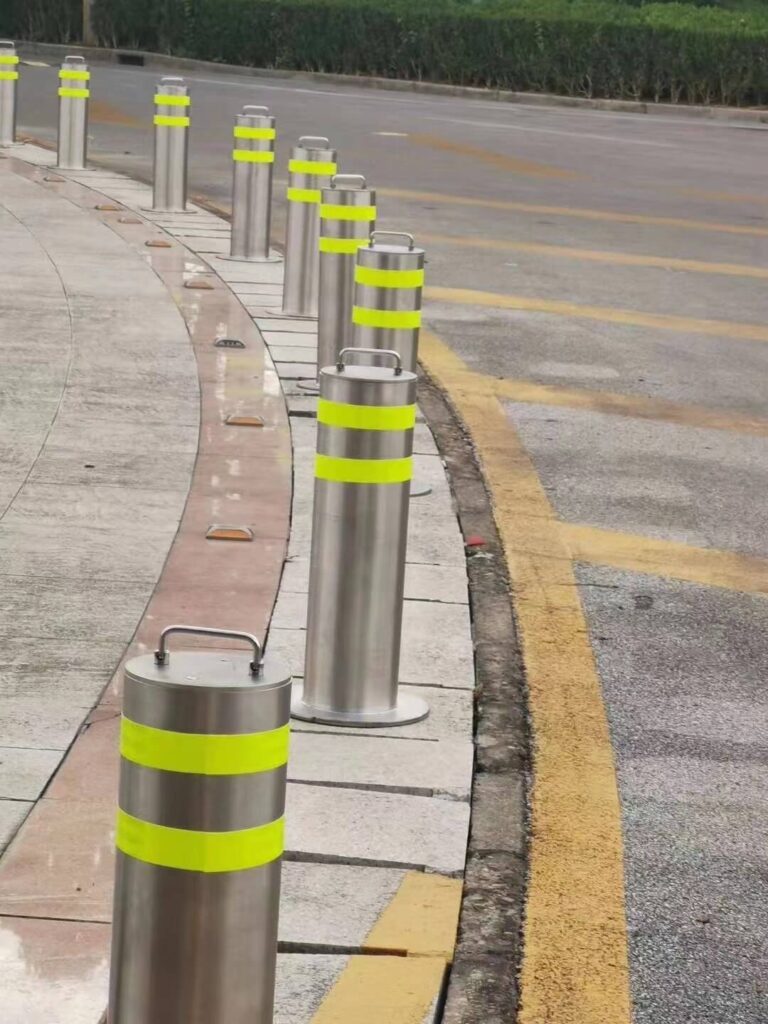
Before comparing suppliers, define what the бульварный столбик must actually do. A pedestrian-zone entrance that opens twice a day has a different requirement from a parking entrance that cycles continuously during peak periods. A private driveway has a different risk profile from a city-centre route that must admit emergency vehicles and scheduled deliveries.
The first specification should therefore describe the operating mission. Record the required raised height, visible diameter, number of bollards, expected cycles per day, peak traffic periods, acceptable opening time, available installation depth, surface type and environmental exposure. Also state whether the unit is intended for access control only or for a verified vehicle-impact protection role.
This last distinction is essential. An automatic bollard can control access without being a crash-rated barrier. A bollard can be wireless without being suitable for hostile-vehicle mitigation. A product can have a strong motor, a thick steel sleeve and a high energy figure without having a recognized full-scale impact test behind the claim.
A useful supplier should ask these questions before recommending a model. If a quotation arrives without any discussion of traffic frequency, vehicle types, foundation conditions or emergency access, the specification process may be starting in the wrong place.
Understand the complete system architecture
An automatic bollard is not just an actuator and a metal tube. It normally includes the visible post, a below-ground or surface-mounted housing, a motor or screw drive, a controller, sensors, a power system, status indicators and one or more access-control methods. Automatic bollard guidance commonly describes control through radio transmitters, cards, intercoms, automatic number-plate recognition, buttons or networked platforms. [1]
For a battery-powered model, the architecture should be explained in even more detail. Ask where the battery is located, whether it is removable, how it is charged, whether the charger is supplied, how the controller monitors state of charge and whether the unit can continue operating locally if a wireless or internet connection is unavailable.
The control method should also fit the operating environment. A simple remote may be appropriate for a low-volume entrance. A managed credential system may be more suitable when access rights change frequently or when a record of commands is required. Smartphone control can be convenient, but it should not make essential access dependent on mobile coverage or a cloud service unless the failure mode is clearly defined.
A mature supplier will explain the boundary between local control and remote management. Which commands are stored locally? What happens after a network interruption? Can a lost remote or phone credential be revoked? Are software updates controlled and documented? How are several bollards synchronized if one unit is obstructed or low on power?
The more public or operationally important the entrance, the less acceptable it is to treat these questions as optional accessories.
Compare battery specifications in usable terms
Battery-powered bollards are often marketed with a simple autonomy statement. One manufacturer may claim more than 500 operations per charge. Another may describe a one-to-two-month charging interval, while another advertises up to six months. Parklio lists a 24 V motor supply and a stated 70% duty cycle for one product, while other product pages describe different motor voltages and battery arrangements. [6] [7] [8] [9]
These figures should not be compared directly. “One operation” may mean one complete raise-and-lower cycle, one movement in one direction or a short test under light load. A six-month claim may assume very low traffic and favorable temperatures. A duty-cycle percentage may refer to the motor control system rather than the battery itself.
Ask for the battery dossier rather than a single headline number. It should identify the chemistry, nominal voltage, capacity in ampere-hours and watt-hours, usable energy, charging method, charger rating, recharge time, temperature limits and battery-management protections. It should also state how capacity is expected to change over time and what condition triggers replacement.
The most useful test is a documented autonomy test under realistic conditions. The supplier should define the load, starting state of charge, number and type of cycles, waiting time between movements, ambient temperature and end-of-test threshold. If winter temperatures or hot enclosures are relevant, request results at the actual operating extremes rather than at room temperature only.
Battery capacity is not the same as operational resilience. A large battery does not solve a poor charging arrangement, an inaccessible enclosure or a controller that cannot report low energy. A smaller battery with clear monitoring, easy exchange and a realistic reserve may be the better design.

Examine what happens when the battery is low or empty
Normal operation is the easiest part of a product demonstration. Supplier quality becomes more visible when the unit is obstructed, disconnected, low on energy or unable to complete its travel.
Ask the supplier to describe the low-battery sequence. Is there a local warning light? Does the system send a remote alarm? Does it stop in the raised position, the lowered position or the position it has reached? Can it complete a movement after a low-energy warning? Is the battery replaceable without removing the whole bollard or excavating the pavement?
The same questions apply to communication loss. If a remote or app command is unavailable, is there a local manual control? If a controller fails, is there a mechanical release? If the bollard is used at an emergency route, who is authorized to operate the override and how quickly can it be reached?
There is no single correct failure state for every site. Keeping a bollard raised may protect a restricted zone but delay emergency entry. Keeping it lowered may preserve vehicle access but weaken the boundary. What matters is that the supplier and the site operator have agreed on the intended response and tested it.
Reliance Foundry notes that incomplete extension or retraction can create a trip hazard and connects reliable operation with regular maintenance, authorized controls and clear operator visibility. [1] That is a useful reminder that failure is not only an electrical issue. A post that stops halfway, becomes difficult to see or cannot be serviced safely creates a public-space problem.
Treat installation as a supplier-selection test
Wireless power can reduce some civil works, but it does not eliminate installation engineering. Retractable bollards still require a suitable foundation or housing, adequate drainage, correct alignment, protection from vehicles and enough access for inspection and repair.
The supplier should provide drawings for the exact model. These should show the excavation or mounting envelope, clearance zones, drainage arrangement, cable or wireless components, service access and any foundation assumptions. A generic catalogue image is not enough.
Site conditions can change the answer. Underground utilities may limit foundation depth. Groundwater may create a higher risk of water ingress. Paving may be difficult to reinstate. A narrow street may not allow service vehicles or lifting equipment. A heritage surface may make future excavation unacceptable. Automatic Systems describes foundation depth, underground services, vehicle class, delivery access and emergency operation as factors in selecting a city access-control arrangement. [10]
Some sellers quote specific excavation depths or include utility scanning, excavation, alignment and surface reinstatement in their installation packages. Those details are useful, but they are product- and site-specific. A stated depth should never become a universal rule for another model. Confirm who is responsible for utility surveys, drainage, concrete work, surface restoration, commissioning and any remedial work caused by site conditions.
My view is that installation should be judged by the future maintenance path as much as by the first-day installation time. A product that avoids mains trenching but requires difficult battery replacement under finished paving may have a lower initial disruption and a higher life-cycle burden.

Verify impact performance with configuration-level evidence
If the bollard has a security role beyond routine access control, require evidence at the correct level. Crash performance is not established by saying that a bollard is heavy, uses thick steel or can absorb a certain number of joules.
Crash-rated bollard guidance commonly discusses standards such as ASTM F2656 and ASTM F3016 and explains that performance includes vehicle speed or mass and a penetration result. It also emphasizes the importance of full-scale testing and the tested foundation and installation configuration. [2] Calspan describes testing services under frameworks including ASTM F2656, ASTM F3016, IWA 14-1, PAS 68 and MASH, and presents installation and documentation as part of the testing process. [3]
A supplier claiming impact performance should provide the exact report or certificate for the exact configuration. Check the model designation, bollard spacing, foundation, installation depth, vehicle mass, impact speed, penetration result, test date and limitations. If the tested product was hydraulic or fixed, do not automatically transfer that result to a battery-powered retractable version.
The same discipline applies to energy figures. One product page reports at least 57,900 joules and at least 50 tonnes of resistance, but does not provide a test method, laboratory, certificate or configuration report on the page. [9] Such a number may be a useful lead for further investigation, but it is not equivalent to an independently traceable crash rating.
A supplier who responds to this request with a generic logo, a marketing label or a standard name without a matching report has not yet provided sufficient evidence.
Separate certification from declaration
Product compliance language can sound more conclusive than it is. CE, RoHS, IP67, IP68, BS1440, Sold Secure and “insurance approved” each require context. The relevant question is not whether a page displays a term. The question is what the term covers, who issued the document, which model it applies to and whether the scope matches the proposed installation.
Ask for the declaration, certificate or test report, the issuing organization, certificate number, date, model range and applicable limitations. For an IP claim, confirm the exact enclosure or assembly that was tested. For a materials statement, confirm the grade, finish and corrosion assumptions. For a safety certification, confirm whether it covers the bollard, the control system, the installation or only a component.
The checked product sources illustrate why this matters. Parklio presents CE and RoHS claims but does not provide certificate copies on the product page. The Guardian page contains both IP67 and IP68 references in different parts of the page. Bollard Security displays “Sold Secure” and “Insurance Approved” labels without showing a certificate scope in the reviewed content. [6] [7] [9]
These observations do not prove that the products are non-compliant. They show why a careful supplier comparison must move from labels to documents. A consistent technical file is itself a sign of engineering discipline.
Evaluate maintenance and spare-parts support
A battery-powered bollard is a maintained asset. Its battery will eventually need replacement. Seals, sensors, chargers, remotes, control boards and mechanical components may also require service. The supplier should explain the preventive-maintenance schedule and identify the parts that are expected to wear or age.
Ask how batteries are exchanged, whether the replacement can be performed by a trained local technician, how long spare batteries will remain available and how old batteries should be stored or disposed of. Ask whether firmware or control software can be updated and whether updates could change remote access behavior.
The warranty should be read as a technical document, not only a commercial promise. Check whether the battery is covered, whether labor and travel are included, what environmental conditions exclude coverage, whether installation by a third party affects the warranty and what happens when a failure occurs during an access restriction period.
Service response should also be measurable. A supplier may offer installation and training, but the reviewed public sources do not provide independently measured response times, spare-parts availability or long-term failure data. [3] [6] [7] [9] Ask for the proposed escalation route, the initial diagnostic process, temporary safety measures and the expected time to restore operation.
The best supplier may not be the one with the most impressive service brochure. It may be the one that can name the parts, procedures and responsibilities clearly.
Use a verification workflow instead of a feature table
A feature table is useful at the beginning, but it should not be the final selection method. The final comparison should be a verification workflow.
First, issue the same technical questions to each supplier. Request the product datasheet, installation drawing, battery dossier, charging instructions, duty-cycle definition, failure-mode description, maintenance schedule, warranty and certificate list. Ask each supplier to identify which statements are tested results and which are design targets or typical values.
Second, turn important claims into acceptance tests. Test opening and closing time under the intended load. Test the stated control range in the real environment. Simulate a low-battery warning. Disconnect communications. Operate the obstruction detection. Check the manual release. Confirm that the bollard sits flush when retracted and is visible when raised. Record the results.
Third, make delivery evidence part of the project. The handover package should include the as-installed drawing, serial numbers, battery and charger details, commissioning results, control credentials, maintenance instructions, spare-parts list and training record. This is more valuable than a box of brochures because it establishes what was actually installed.
Finally, compare total ownership cost. Include installation, charging equipment, battery replacement, preventive maintenance, spare parts, service travel, surface reinstatement and end-of-life disposal. A low purchase price can become expensive if a battery cannot be sourced, a fault requires specialist travel or a minor repair requires excavation.
Questions that reveal supplier maturity
A short technical conversation can reveal a great deal. Ask: What is the defined operation in your autonomy claim? What is the minimum reserve before the system stops? What happens when the battery is flat? Can the unit be manually released? What is the tested temperature range? Which exact configuration has been impact-tested? What foundation was used? Can you provide the report rather than only the rating?
Then ask operational questions. Who installs the unit? Who scans for utilities? Who owns drainage performance? How is a replacement battery ordered? How long are spare parts retained? What information is logged after a fault? Can the system operate without internet access? What happens when a remote is lost? Which parts can be replaced without excavation?
A supplier does not need to claim that every product suits every situation. In fact, a clear statement that a model is not intended for high-frequency operation, heavy trucks or crash protection can be a positive sign. Boundaries make a specification more credible.
The best supplier is the one with the clearest evidence
Battery-powered automatic булы can be an effective response to sites where flexible access, low-disruption installation and selective control are important. Their value is real, but it depends on more than the battery and the wireless remote.
The right supplier should connect the product to the site mission, explain the energy system in usable terms, document failure behavior, provide model-specific installation information and separate access-control capability from impact performance. It should also offer a practical route for maintenance, battery replacement, training and future service.
The most reliable purchasing decision is therefore not based on the strongest marketing phrase. It is based on evidence that can be checked before installation and tested after installation. Compare suppliers by the quality of their questions, the consistency of their documents and the honesty of their limitations.
A bollard that works well on the day of installation is useful. A bollard whose energy, controls, safety behavior, certification, maintenance and service path are understood is a sounder piece of urban infrastructure.