Introduction
In an era where the security of public infrastructure is under constant scrutiny, the physical protection of government buildings has become a paramount concern for architects, urban planners, and security professionals alike. Government facilities, ranging from local municipal offices and courthouses to federal headquarters and embassies, serve as the backbone of civil society. However, their symbolic importance and the critical functions they house also make them potential targets for a variety of threats, both intentional and accidental. Among the diverse array of security measures available, the humble bollard has emerged as one of the most effective and versatile tools in the perimeter security arsenal.
The primary challenge in securing government buildings lies in the delicate balance between robust protection and public accessibility. Unlike military bases or industrial sites, government buildings must remain open and welcoming to the citizens they serve. A “fortress mentality” that relies on high walls and restrictive barriers can inadvertently alienate the public and diminish the democratic character of these institutions. Bollards offer a sophisticated solution to this dilemma. By providing a formidable physical barrier against vehicle-borne threats while allowing pedestrians to move freely, they maintain the openness of public spaces without compromising on safety.
As we delve into the complexities of modern perimeter security, it becomes clear that bollards are far more than simple posts in the ground. They are precision-engineered safety systems designed to withstand immense forces and integrate seamlessly into the architectural fabric of our cities. This article explores the multifaceted role of bollards in protecting government buildings, examining the technical standards that define their performance, the various types suited for different applications, and the strategic considerations involved in their implementation.

Understanding the Threat Landscape
To appreciate the necessity of bollards in government building security, one must first understand the nature of the threats they are designed to mitigate. The most significant concern in this context is the use of vehicles as weapons, a tactic known as Hostile Vehicle Attacks (HVA). These attacks can take several forms, including ramming into building entrances to gain unauthorized access, targeting pedestrian crowds in plazas, or delivering improvised explosive devices (IEDs) in close proximity to a structure.
The phenomenon of vehicle ramming has gained prominence in recent years due to its simplicity and effectiveness. A standard passenger vehicle or a commercial truck can be transformed into a high-energy projectile with the potential to cause catastrophic structural damage and loss of life. For government buildings, which often feature large glass facades or open plazas, the vulnerability to such attacks is particularly acute. Without a physical barrier to arrest the momentum of a speeding vehicle, the distance between a potential threat and a high-value target is dangerously short.
However, the threat landscape is not limited to intentional acts of malice. Accidental vehicle incursions are a far more frequent occurrence and can be equally devastating. Driver error, medical emergencies, or mechanical failures can lead to vehicles jumping curbs and crashing into buildings or pedestrian areas. In busy urban environments where government offices are located, the proximity of high-volume traffic to public walkways creates a constant risk. Bollards serve as a critical safety net in these scenarios, preventing a tragic accident from escalating into a major disaster.
Assessing the risk for a specific government facility requires a comprehensive analysis of its surroundings. Security professionals must identify “vulnerable points” such as main entrances, loading docks, and areas where vehicles can gain significant speed before impact. The goal is to create a “stand-off distance”—a buffer zone that keeps potential threats at a safe distance from the building’s core. By strategically placing bollards at these critical junctures, planners can effectively manage vehicle movement and ensure that only authorized traffic can approach sensitive areas.
The Science of Protection: Crash Ratings and Standards
The effectiveness of a security bollard is not determined by its appearance, but by its ability to perform under extreme stress. To provide a reliable baseline for security planning, the industry relies on rigorous crash-testing standards. These standards ensure that when a bollard is rated for a specific impact, it has been proven to stop a vehicle of a certain weight traveling at a designated speed. For government buildings, where the stakes are highest, understanding these ratings is essential for making informed procurement decisions.
ASTM F2656: The Gold Standard for High-Security Barriers
In the United States and increasingly worldwide, the ASTM F2656 standard is the primary benchmark for evaluating the performance of vehicle security barriers. This standard replaced the legacy “K-ratings” used by the Department of State and provides a more nuanced grading system. ASTM F2656 tests barriers against several vehicle classes, but the most common for government applications is the “M” (Medium-duty truck) class, which simulates a 15,000 lb (6,800 kg) vehicle.
The ratings are categorized by the speed at which the test vehicle impacts the barrier:
- **M30**: Tested at 30 mph (48 km/h).
- **M40**: Tested at 40 mph (64 km/h).
- **M50**: Tested at 50 mph (80 km/h).
In addition to the speed, the ASTM standard measures the “penetration distance”—how far the vehicle’s payload travels past the barrier after impact. This is a crucial metric for government buildings with limited setback distances. The penetration levels are:
- **P1**: ≤ 3.3 ft (1.0 m). This is the highest level of protection, ensuring the vehicle is stopped almost instantly.
- **P2**: 3.31 ft to 23.0 ft (1.01 m to 7.0 m).
- **P3**: 23.1 ft to 98.4 ft (7.01 m to 30.0 m).
For a high-security government facility, an **M50-P1** rating is often the requirement, as it signifies the ability to stop a 15,000 lb truck traveling at 50 mph with minimal penetration. This level of performance provides the maximum possible assurance against a determined hostile vehicle attack.
International Standards: PAS 68 and IWA 14-1
While ASTM is the standard in the U.S., other regions utilize the PAS 68 (United Kingdom) and IWA 14-1 (International) standards. PAS 68 was the first British standard for vehicle security barriers and uses a similar testing methodology to ASTM, though its reporting format is slightly different. It includes details on the vehicle type, mass, speed, and the angle of impact.
IWA 14-1 is a newer, international agreement that aims to harmonize the various regional standards. It combines elements of both ASTM and PAS 68 to provide a globally recognized framework for crash testing. For manufacturers and specifiers working on international government projects, such as embassies or multi-national headquarters, familiarity with IWA 14-1 is vital for ensuring compliance across different jurisdictions.
ASTM F3016: Addressing Low-Speed Safety
Not every area of a government campus requires the highest level of anti-ram protection. In pedestrian plazas, along sidewalks, or near parking structures, the primary concern may be accidental low-speed impacts. The ASTM F3016 standard was developed specifically to address these scenarios. It tests barriers against a 5,000 lb (2,270 kg) surrogate vehicle at speeds of 10, 20, and 30 mph.
Using F3016-rated bollards in lower-risk areas allows government agencies to enhance public safety without the significant cost and infrastructure requirements of full crash-rated systems. This tiered approach to security ensures that resources are allocated efficiently while still providing a comprehensive safety net for the entire facility.

Types of Bollards for Government Applications
Government buildings present a unique set of operational requirements that necessitate a variety of bollard types. From permanent perimeters to flexible access points, selecting the right bollard depends on the specific security needs and the intended use of the space.
Fixed/Static Bollards: Permanent Perimeter Protection
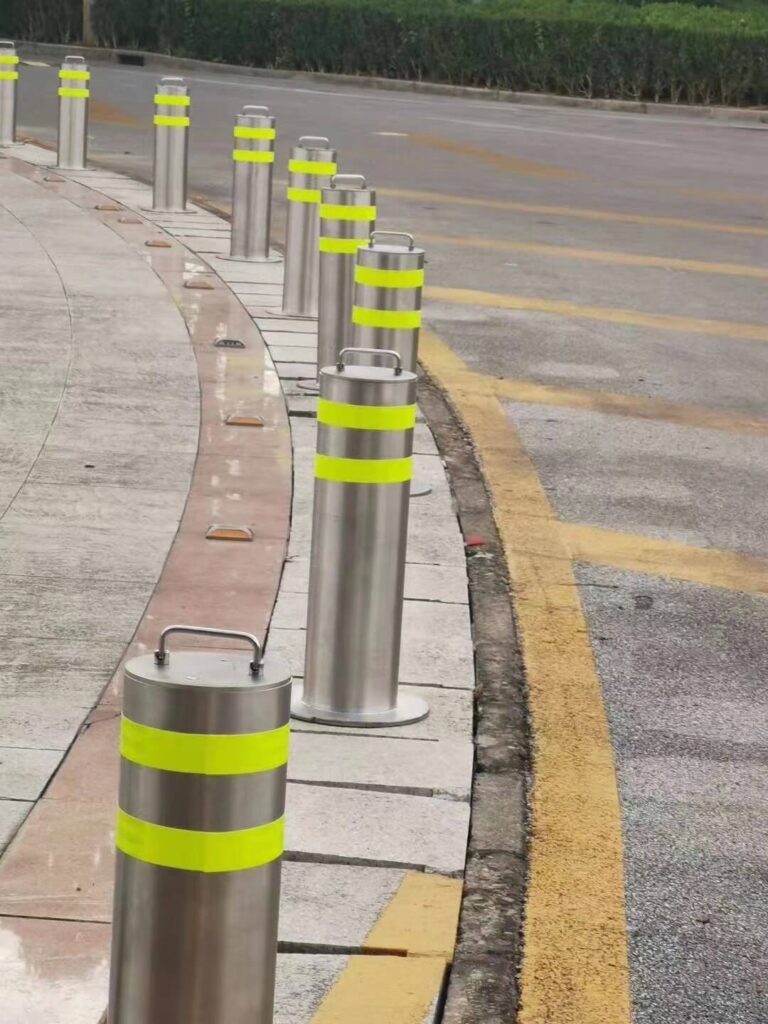
Fixed or static bollards are the most common type used for securing government facilities. These are permanently installed in the ground and provide a robust, non-movable barrier against vehicle incursions. They are typically constructed of high-strength steel and filled with concrete to enhance their structural integrity. For government buildings, fixed bollards are ideal for creating a continuous perimeter along sidewalks, around plazas, and in front of main entrances.
The installation of fixed bollards requires careful consideration of the underground infrastructure. In many urban environments, government buildings are surrounded by a dense network of utilities, including water pipes, electrical conduits, and telecommunications cables. Traditional fixed bollards require deep foundations, often several feet deep, to provide the necessary resistance against impact. In some cases, these deep foundations are not feasible due to the presence of utilities.
Shallow Mount Bollards: Overcoming Infrastructure Constraints
To address the challenges of underground utilities, shallow mount bollards have become a popular solution for government building security. These bollards are designed with a unique base system that requires a significantly shallower foundation—often as little as 6 to 12 inches deep. The shallow mount system distributes the force of an impact across a wider area, allowing it to provide the same level of crash protection as traditional deep-foundation bollards.
Shallow mount bollards are particularly advantageous for retrofitting existing government buildings where the cost and complexity of relocating utilities would be prohibitive. They also allow for faster installation with minimal disruption to the surrounding area. For high-security facilities in historic urban centers, shallow mount technology is often the only viable option for implementing a crash-rated perimeter.
Removable Bollards: Flexibility for Occasional Access
While permanent protection is essential, some areas of a government campus may require occasional vehicle access. For example, a pedestrian plaza might need to accommodate emergency vehicles, maintenance trucks, or event-related traffic. Removable bollards provide the necessary flexibility for these scenarios. These bollards can be manually removed from their ground sockets when access is needed and securely locked back into place when protection is required.
Removable bollards are available in both non-rated and crash-rated versions. For government buildings, it is critical to select crash-rated removable bollards for areas that are part of the main security perimeter. This ensures that the level of protection remains consistent even when the bollards are in place.
Retractable/Automatic Bollards: Dynamic Access Control
For high-traffic entrances and sensitive areas that require frequent vehicle access, retractable or automatic bollards are the ideal choice. These bollards can be raised or lowered in seconds using a hydraulic, pneumatic, or electric drive system. They can be integrated with various access control technologies, such as RFID readers, license plate recognition (LPR) cameras, or remote-control systems.
Automatic bollards provide a seamless way to manage vehicle movement while maintaining a high level of security. In a government setting, they are often used at the entrances to secure parking areas, loading docks, and restricted roadways. Their ability to respond quickly to a security threat—rising into position in just a few seconds—makes them an invaluable tool for preventing unauthorized vehicle entry.
Architectural Integration: Balancing Security and Aesthetics
One of the most significant trends in modern perimeter security is the integration of safety measures into the architectural design of public spaces. For government buildings, which often serve as landmarks and symbols of civic pride, the aesthetic impact of security bollards is a major consideration. The goal is to create a secure environment that feels open, inviting, and respectful of its surroundings.
Moving Beyond “Fortress Mentality”
In the past, security measures for government buildings were often unsightly and utilitarian, creating a sense of isolation and fear. Today, architects and security planners are moving away from this “fortress mentality” in favor of more integrated and aesthetically pleasing solutions. Bollards play a central role in this shift. By using decorative sleeves and custom finishes, bollards can be transformed from simple steel posts into elegant architectural elements that complement the building’s design.
Decorative bollard covers are available in a wide range of materials, including cast iron, aluminum, and stainless steel. They can be designed to match the historic character of a courthouse or the sleek, modern lines of a contemporary federal office. Some bollards are even designed to serve dual purposes, such as providing seating, integrated lighting, or wayfinding information. This multi-functional approach ensures that security measures add value to the public space rather than detracting from it.

Lighting and Smart Features
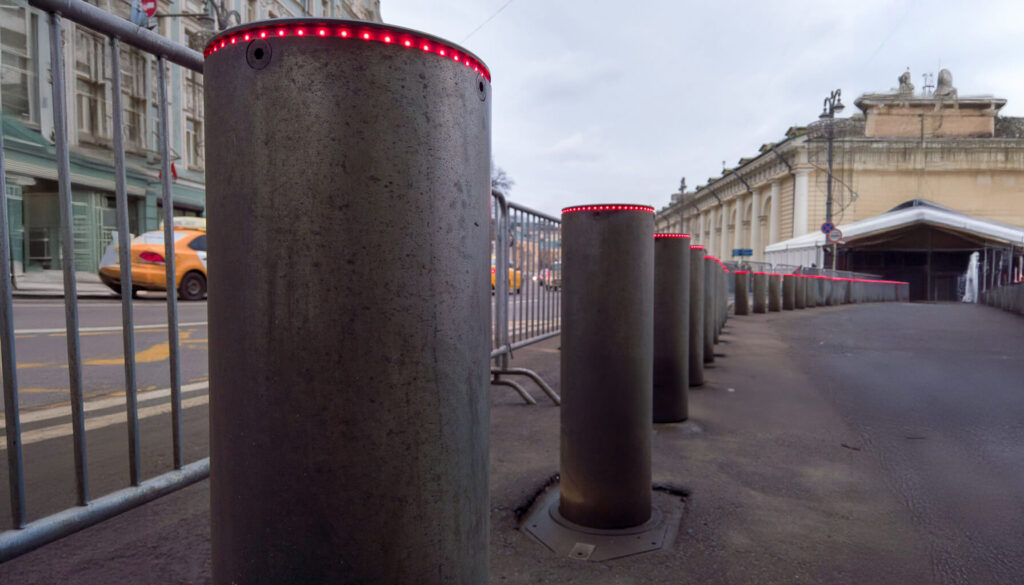
Integrating technology into physical barriers is another way to enhance both security and aesthetics. Bollards with integrated LED lighting can provide essential illumination for pedestrian walkways and plazas, improving safety and visibility at night. These “bollard lights” can be designed to match the overall lighting scheme of the facility, creating a cohesive and well-lit environment.
Furthermore, “smart bollards” are beginning to emerge as a new frontier in urban security. These bollards can be equipped with sensors to monitor traffic flow, detect unauthorized vehicle movement, or even provide public Wi-Fi access. For government agencies looking to implement smart city technologies, integrated bollards offer a unique platform for deploying various sensors and communication devices throughout a facility’s perimeter.
Case Study: Historic vs. Modern Integration
The challenge of integrating bollards varies significantly between historic and modern government buildings. For a historic courthouse, the goal might be to use traditional-style bollards with ornate cast-iron sleeves that blend seamlessly with the existing architecture. In contrast, a modern federal building might feature sleek, stainless steel bollards with minimalist designs and integrated LED lighting.
In both cases, the key to successful integration is early collaboration between architects, landscape designers, and security professionals. By considering perimeter security as an integral part of the overall site design, planners can ensure that bollards are both effective and aesthetically pleasing. This proactive approach results in a secure facility that remains a welcoming and vibrant part of the community.
Planning and Implementation: A Strategic Approach
The successful implementation of a security bollard system for a government building requires a strategic approach that goes beyond simply selecting a crash-rated product. It involves a comprehensive analysis of the site’s unique characteristics, the potential threats it faces, and the operational requirements of the facility.
Site Assessment and Vulnerability Analysis
The first step in planning a bollard system is a thorough site assessment and vulnerability analysis. This process involves identifying the critical assets that need protection, such as the building’s main entrance, structural columns, and utility hubs. Security professionals also analyze the surrounding area to determine the potential “attack vectors”—the routes that a vehicle could take to reach these assets.
The vulnerability analysis considers factors such as the distance between the road and the building (setback distance), the speed limits on nearby streets, and the presence of any natural or man-made obstacles. By mapping out these variables, planners can identify the most vulnerable points and determine the appropriate level of protection for each area.
Setback Distances and the Physics of Impact
One of the most critical factors in determining the effectiveness of a bollard system is the setback distance—the distance between the bollards and the building they are protecting. The goal is to maximize this distance to provide a “stand-off zone” that keeps a potential threat at a safe distance.
The physics of impact also play a significant role in bollard placement. When a vehicle hits a bollard, the energy of the impact is transferred to the bollard and its foundation. The amount of energy is determined by the vehicle’s mass and its speed. For government buildings, it is essential to consider the “worst-case scenario”—a heavy vehicle traveling at high speed.
Planners use this information to determine the spacing between bollards. To prevent a vehicle from squeezing through the gaps, bollards are typically spaced no more than 4 to 5 feet apart. This spacing ensures that even a small passenger car cannot pass through the perimeter while still allowing pedestrians and wheelchair users to move freely.
Compliance with Local and Federal Regulations
The implementation of security bollards must also comply with various local and federal regulations. For government buildings in the United States, compliance with the Americans with Disabilities Act (ADA) is a primary concern. Bollards must be spaced and positioned in a way that does not impede the movement of individuals with disabilities.
In addition to ADA compliance, government agencies must also consider local building codes, fire safety regulations, and environmental standards. For example, some jurisdictions may have specific requirements for the materials and finishes used for bollards to ensure they are durable and resistant to corrosion.
Maintenance and Longevity
To ensure the continued effectiveness of a security bollard system, regular maintenance and inspection are essential. This is particularly true for automatic and retractable bollards, which have moving parts and electronic components that require periodic servicing.
Material Selection: Stainless Steel, Galvanized Steel, and Powder Coating
The longevity of a bollard system is largely determined by the materials used in its construction. For government buildings, stainless steel is a popular choice due to its exceptional durability and resistance to corrosion. It is also aesthetically pleasing and can be polished to a high sheen or given a brushed finish.
Galvanized steel is another common material for security bollards. It is treated with a protective zinc coating to prevent rust and corrosion. For added durability and aesthetic appeal, galvanized steel bollards can be powder-coated in a wide range of colors. Powder coating provides a tough, scratch-resistant finish that can withstand the rigors of an urban environment.
Ensuring Operational Readiness for Automatic Systems
Automatic and retractable bollard systems require a more rigorous maintenance schedule than fixed bollards. This includes regular inspections of the hydraulic or electric drive systems, testing the sensors and access control devices, and ensuring that the bollards rise and lower smoothly.
Regular maintenance is critical for ensuring that automatic bollards are always ready to respond to a security threat. A malfunction in an automatic bollard system could leave a critical entrance vulnerable to unauthorized vehicle entry. By implementing a proactive maintenance program, government agencies can minimize the risk of system failure and ensure the long-term reliability of their security infrastructure.
Impact of Environmental Factors
Environmental factors such as weather, road salt, and pollution can also impact the performance and appearance of security bollards. In coastal areas, the high salt content in the air can accelerate corrosion, making stainless steel or specialized coatings essential. In regions with harsh winters, road salt used for de-icing can also damage bollard finishes and foundations.
Regular cleaning and inspection can help mitigate the effects of environmental factors. For example, rinsing bollards with fresh water to remove salt and debris can extend the life of their finishes. Any signs of rust or damage should be addressed promptly to prevent further deterioration.
Conclusion
As the security landscape continues to evolve, the role of bollards in protecting government buildings has never been more critical. From providing a formidable defense against hostile vehicle attacks to ensuring the safety of pedestrians in busy urban plazas, bollards are a versatile and indispensable tool for modern perimeter security.
The successful implementation of a bollard system requires a deep understanding of the technical standards that define their performance, the various types suited for different applications, and the strategic considerations involved in their planning and maintenance. By taking a proactive and integrated approach to security, government agencies can create a safe and welcoming environment for the citizens they serve.
Looking ahead, the future of perimeter security will be shaped by the continued integration of technology and the growing emphasis on sustainable and aesthetically pleasing design. “Smart bollards” with integrated sensors and lighting will become more common, providing new ways to monitor and manage public spaces. At the same time, the focus on creating inviting and accessible government campuses will continue to drive innovation in decorative and multi-functional bollard designs.
In the end, the true value of a security bollard lies in the peace of mind it provides. For the people who work in and visit government buildings, knowing that they are protected by a robust and reliable safety system is essential for maintaining the openness and vitality of our civic institutions. Bollards are not just simple posts in the ground; they are a fundamental commitment to the safety and security of our public infrastructure.
—
This article was prepared by a professional Chinese bollard manufacturer with a commitment to excellence in security and design. For more information on our range of crash-rated and architectural bollards, please visit our website.