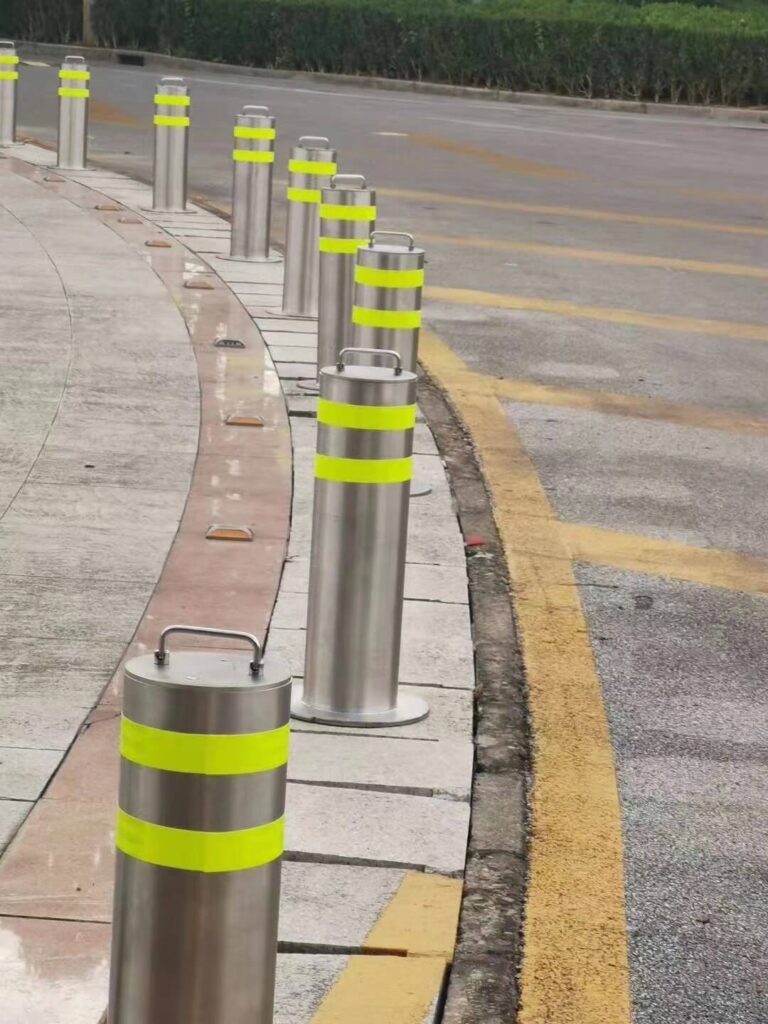
Can I put a bollard on my parking space?

If you own the property, you generally can install a bollard without permission. However, shared ownership or public spaces may require approval from landlords or local authorities. Bollards provide security, prevent damage, and improve parking management.
Where should bollards be placed?

Bollards should be placed at building entrances, parking lots, public spaces, and high-security areas to protect pedestrians and property. Consider their purpose—security, traffic control, or aesthetics—and ensure compliance with safety regulations for optimal placement.
How deep should a bollard be buried?

Bollards should typically be buried between 24 to 48 inches deep, depending on their purpose. Security bollards for crash protection may require deeper installation, especially in loose soil or areas with frost lines to ensure long-term stability.
Do bollards need to be filled with concrete?

Not always. Concrete adds weight and stability, but it can make bollards brittle and prone to cracking on impact. Alternatives like steel or composite materials can provide better flexibility and impact absorption in high-risk areas, depending on the use case.
How strong are concrete bollards?

Concrete bollards are highly durable and can stop vehicles in low to moderate-speed environments, thanks to their high compressive strength and steel reinforcement. Their strength depends on material composition, installation depth, and environmental factors.
Do bollards have to be painted yellow?

While yellow is widely used for safety due to its high visibility and association with caution, it’s not always mandatory. OSHA recommends yellow in high-risk areas, but alternatives can be chosen for aesthetic purposes, provided they maintain adequate visibility and safety.
What is the BS standard for bollards?

The British Standards (BS) for bollards, such as BS EN 12767 and PAS 68, outline specifications for crash resistance, durability, and safety. These standards ensure bollards are tested for vehicle impact, environmental factors, and compliance with security regulations.
How much force can a bollard stop?

Bollards can stop a 5,000 lbs vehicle traveling at 30 mph, depending on the material, design, and crash rating. Steel and concrete bollards offer the highest protection. The effectiveness is influenced by factors such as installation depth and crash test ratings like ASTM and PAS 68.
Can a bollard stop a truck?

Bollards can stop trucks when designed as crash-rated barriers. High-impact bollards made of steel and concrete, deeply embedded into the ground, can halt vehicles up to 15,000 lbs at 30 to 50 mph.
Proper installation and regular maintenance ensure their effectiveness.