
Introdução
The landscape of perimeter security is undergoing a significant transformation. For decades, the gold standard for vehicle access control was the hardwired automatic bollard—a robust, immovable sentinel that required extensive civil engineering, deep trenching, and complex electrical integration. However, as urban environments become more congested and the demand for flexible, “smart” infrastructure grows, a new contender has emerged: the Battery Powered Automatic Bollard.
This article provides a deep dive into the technology, mechanics, and strategic advantages of battery-operated systems. Beyond simple convenience, we will explore why this shift represents a fundamental change in how we approach physical security and urban mobility
The Concept: Defining the Battery-Powered Automatic Bollard
At its core, a battery-powered automatic bollard is a self-contained vehicle access control device that operates independently of the local power grid. Unlike traditional retractable bollards that rely on a continuous AC power supply and underground cabling, these units utilize high-capacity, rechargeable internal batteries to drive their movement.
The primary innovation here is not just the power source itself, but the autonomy it provides. By decoupling the security hardware from the electrical grid, property managers and urban planners can deploy high-level security measures in locations where traditional installations would be cost-prohibitive or physically impossible.
Key Components of the System
| Component | Description |
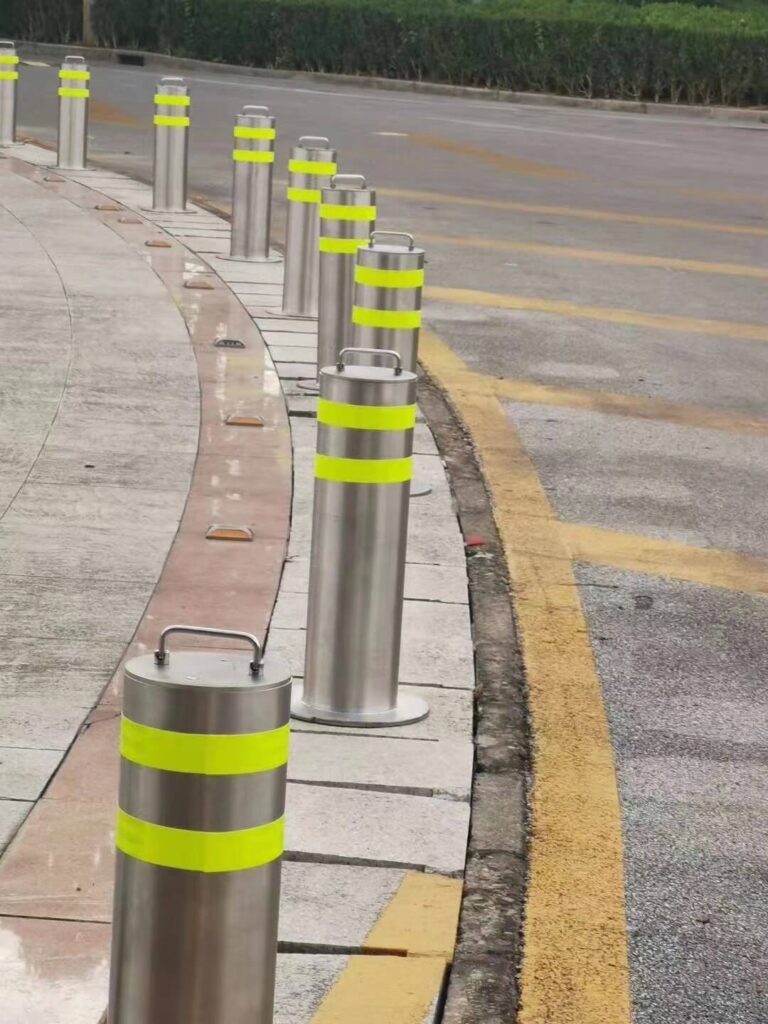
| **Bollard Cylinder** | The visible, rising part of the system, typically made of high-grade stainless steel or carbon steel. |
| **Drive Unit** | The internal mechanism (electro-mechanical or hydraulic) that converts electrical energy into vertical motion. |
| **Battery Pack** | High-density lithium-ion or lead-acid batteries designed for deep-cycle use and extreme temperature resilience. |
| **Control Logic** | The “brain” of the unit that manages remote signals, safety sensors, and power consumption. |
| **Recharge Interface** | Often integrated with solar panels or quick-connect charging ports for periodic maintenance. |
How They Work: The Internal Mechanics
To understand how these systems function without a constant power tether, we must look at the efficiency of their internal drive systems. Most battery-powered bollards utilize one of two primary mechanisms: Electro-Mechanical Screw Drives or Micro-Hydraulic Systems.
1. Electro-Mechanical Screw Drive
This is the most common mechanism for battery-operated units due to its high energy efficiency. A high-torque DC motor is connected to a lead screw or ball screw. When the motor rotates, the screw moves the bollard cylinder up or down.
- Efficiency: Because there is no fluid to compress or circulate, nearly all the battery’s energy is converted directly into movement.
- Self-Locking: The nature of a screw drive provides inherent self-locking capabilities. Once the bollard is raised, it cannot be forced down by external pressure without rotating the screw, providing high static resistance.
2. Micro-Hydraulic Systems
Some high-security battery bollards use a localized hydraulic pump. The battery powers a small motor that moves hydraulic fluid into a cylinder to raise the bollard.
- Force: These systems can often generate more lifting force, making them suitable for heavier, crash-rated bollards.
- Complexity: They require more intensive maintenance (seals and fluid checks) compared to electro-mechanical drives but offer superior performance in high-frequency applications.
Power Management and Logic
The “magic” of a battery-powered bollard lies in its Sleep Mode logic. To conserve energy, the bollard’s receiver and control board operate in a low-power state, “waking up” only when they receive a signal from a remote control, smartphone app, or RFID reader. This allows a single charge to last for hundreds, or even thousands, of cycles.

Comparative Analysis: Battery vs. Hardwired Systems
When evaluating security infrastructure, it is essential to look beyond the initial purchase price and consider the Total Cost of Ownership (TCO) and operational flexibility.
1. The Infrastructure Burden
Traditional hardwired bollards are “infrastructure-heavy.” They require:
- Trenching through concrete or asphalt to lay conduit.
- Professional electrical tie-ins to the building’s main power.
- Substantial surface restoration after installation.
In contrast, battery-powered bollards are “infrastructure-light.” They require only a foundation hole. There is no need to disturb existing underground utilities or navigate complex electrical permits.
2. Reliability During Power Outages
One of the most significant professional insights in the industry is the vulnerability of grid-dependent security. In a power failure, a traditional bollard remains in its last state (usually down for safety, or requiring manual override). A battery-powered bollard, however, remains fully operational. It is inherently its own “Uninterruptible Power Supply” (UPS).
3. Comparison Table
| Feature | Hardwired Automatic | Battery Powered Automatic |
| **Installation Time** | 5–10 Days | 1–2 Days |
| **Civil Work Cost** | High (Trenching required) | Low (No trenching) |
| **Grid Dependency** | 100% Dependent | Independent |
| **Maintenance** | Electrical & Mechanical | Battery Replacement (3-5 years) |
| **Environmental Impact** | Continuous energy draw | Solar-compatible / Zero idle draw |
Professional Viewpoint: The Paradigm Shift to “Infrastructure-Free” Security
From a manufacturing and strategic perspective, the rise of battery-powered bollards represents more than just a technological iteration; it is a paradigm shift.
The Fallacy of the “Permanent” Installation
Historically, perimeter security was seen as a permanent, immovable part of a building’s architecture. However, modern urban spaces are dynamic. Pop-up markets, temporary pedestrian zones, and evolving security threats require a more agile approach. Battery-powered bollards allow for “semi-permanent” security—installations that can be deployed quickly and even moved if the site’s requirements change over a decade.
The Hidden Risk of Underground Cabling
A viewpoint often overlooked by general contractors is the long-term fragility of underground wiring. In regions with shifting soil, high water tables, or frequent construction, underground conduits are prone to failure. Identifying and repairing a cable break 2 meters underground is an expensive nightmare. By eliminating the cables, we eliminate the single most common point of failure in automatic access control systems.
Total Cost of Ownership (TCO): A 10-Year Perspective
When we analyze the costs over a decade, the battery-powered option often emerges as the more economical choice, despite the need for periodic battery replacements. To truly understand the financial implications, we must break down the lifecycle into three distinct phases: Acquisition and Installation, Operational Maintenance, and Infrastructure Risk Management.
Phase 1: Acquisition and Installation (The CAPEX Advantage)
The “sticker price” of a battery-powered bollard might be slightly higher than a basic hardwired unit due to the integrated battery and sophisticated control logic. However, the Capital Expenditure (CAPEX) is drastically lower when the total site work is factored in.
For a typical four-unit installation at a corporate entrance, a hardwired system requires a trench of approximately 30 to 50 meters. The cost of labor for excavation, the price of specialized conduit, and the fees for a certified electrician to perform the final tie-in can easily exceed $15,000. In contrast, the battery-powered system requires only the foundation holes for the bollards themselves. This “plug-and-play” nature allows for a 70-85% reduction in civil engineering costs, providing an immediate return on investment.
Phase 2: Operational Maintenance (The OPEX Reality)
Critics of battery systems often point to the recurring cost of battery replacements. It is true that high-quality lithium-ion packs have a service life of 3 to 5 years depending on cycle frequency and environmental conditions. However, let’s compare this to the Operating Expenditure (OPEX) of a hardwired system.
A hardwired system consumes a small but constant “phantom load” of electricity. More importantly, it requires periodic inspections of junction boxes, surge protection devices, and the central control cabinet. Over ten years, the cost of replacing two sets of batteries is remarkably similar to the cumulative maintenance costs of a complex wired network. The difference is that battery replacement is a predictable, scheduled event, whereas electrical component failure is often an emergency repair.
Phase 3: Infrastructure Risk Management (The Hidden Savings)
The most significant professional insight regarding TCO is the “Infrastructure Risk.” In any urban environment, the ground is a crowded space. Underground cables are vulnerable to:
- Accidental Strikes: During unrelated repairs to water mains or fiber optic lines.
- Environmental Degradation: Water ingress into conduits, leading to short circuits.
- Rodent Damage: Which can disable an entire security perimeter overnight.
A single cable fault in a hardwired system can cost thousands of dollars to locate and repair, often requiring new excavation. By eliminating the underground infrastructure, battery-powered bollards effectively eliminate this entire category of financial risk.
Strategic Applications: Where Battery Power Excels
While battery-powered bollards are versatile, there are specific scenarios where their unique properties provide an overwhelming advantage over traditional systems.
1. Historical and Heritage Sites
Preserving the architectural integrity of historical sites is a major challenge for security professionals. Trenching through 18th-century cobblestones or near the sensitive foundations of ancient monuments is often prohibited by law. Battery-powered bollards provide a non-invasive solution, allowing for high-level security without disturbing the historical substrate.
2. High Water Table and Coastal Areas
In coastal cities or regions with high water tables, maintaining the integrity of underground electrical conduits is a constant struggle. Saltwater ingress can corrode wiring and cause frequent system failures. Because battery-powered units are self-contained and can be sealed to IP68 standards without external cable entries, they are inherently more resilient to moisture-related failures.
3. Remote and Rural Perimeters
Securing the entrance to a remote utility site, a private estate, or a rural research facility often involves bringing power from hundreds of meters away. The cost of running high-voltage lines over long distances can be ten times the cost of the security hardware itself. Battery-powered bollards, especially when paired with solar charging, provide “off-grid” security that is both functional and fiscally responsible.
4. Temporary and Modular Security
Modern event management requires security that can scale. Whether it’s a high-profile summit, a seasonal festival, or a temporary construction zone, the ability to install professional-grade automatic bollards for a period of months and then relocate them is a game-changer. This modularity is only possible when the units are not tethered to the grid.
The Engineering Perspective: Overcoming Common Myths
As a manufacturer, we often encounter misconceptions regarding the capabilities of battery-powered systems. It is important to address these with technical facts.
Myth 1: “Battery bollards are only for light-duty parking protection.”
The Reality: Modern battery-powered units can drive heavy, crash-rated cylinders. The limitation is not the weight of the bollard, but the efficiency of the motor and the capacity of the battery. High-end systems can easily handle cylinders weighing over 150kg, providing the same level of physical deterrence as hardwired units.
Myth 2: “They will fail in the winter.”
The Reality: While it is true that standard lead-acid batteries struggle in the cold, professional-grade bollards use specialized Lithium Iron Phosphate (LiFePO4) or Nickel-Metal Hydride (NiMH) chemistries designed for wide temperature ranges. When combined with thermal insulation and smart heaters powered by the battery itself during charging cycles, these units remain operational in temperatures as low as -30°C.
Myth 3: “The battery will die and the bollard will be stuck.”
The Reality: Professional systems include multiple layers of redundancy. First, low-battery alerts are sent to the management system long before the unit ceases to function. Second, most units feature a “fail-safe” or “fail-secure” mode that can be pre-configured. Finally, a manual mechanical override is always available, allowing the bollard to be lowered with a specialized key even if the battery is completely depleted.
Future Trends: The Intersection of AI and Autonomous Security
The evolution of battery-powered bollards is closely tied to the broader trends in the “Internet of Things” (IoT) and Artificial Intelligence (AI).
Predictive Maintenance
The next generation of battery-powered bollards will utilize AI to analyze their own performance data. By monitoring the speed of the rising cycle and the current draw of the motor, the system can predict when a component is nearing failure or when the battery’s health is declining. This allows for “just-in-time” maintenance, further reducing the TCO.
Mesh Networking and Crowd Intelligence
When multiple battery-powered bollards are deployed across a campus, they can form a wireless mesh network. If one unit detects a security breach or a vehicle impact, it can signal the entire perimeter to rise. This collective intelligence ensures that the security system reacts as a single, cohesive unit, despite the lack of physical wires connecting them.
Integration with Autonomous Vehicles (AVs)
As self-driving cars become more common, the communication between vehicles and infrastructure (V2I) will be critical. Battery-powered bollards, equipped with Short-Range Communication (DSRC) or 5G modules, will be able to communicate directly with authorized AVs, lowering automatically as the vehicle approaches and rising immediately after it passes, ensuring seamless and secure traffic flow.
Case Study Scenario: Urban Pedestrianization
Imagine a bustling city center that wants to convert a major thoroughfare into a pedestrian zone during weekends.
The Traditional Approach: The city would need to dig up the street, lay miles of cable, and install a central control room. The project would take six months and cost millions.
The Battery-Powered Approach: The city installs a series of battery-powered automatic bollards at each entry point. The installation takes two weeks. The bollards are programmed to rise automatically at 6:00 PM on Friday and lower at 6:00 AM on Monday. During the week, they remain flush with the ground, allowing normal traffic. The entire system is managed via a cloud-based app, and the units are kept charged by integrated solar mats on the bollard lids.
This scenario highlights the true value of battery-powered technology: it empowers city planners to be bold and flexible with their urban design, without being held back by the limitations of 20th-century infrastructure.
Summary of Technical Specifications for High-End Units
| Feature | Specification Range |
| **Material** | AISI 304 / 316 Stainless Steel or High-Strength Carbon Steel |
| **Rising Height** | 600mm – 1000mm (Customizable) |
| **Diameter** | 168mm – 324mm |
| **Rising Speed** | 3 – 8 seconds (Adjustable) |
| **Battery Life** | 3,000 – 5,000 total charge cycles |
| **Protection Level** | IP67 (Standard) / IP68 (Submersible) |
| **Control Options** | Remote, Smartphone, RFID, LPR (License Plate Recognition) |
| **Impact Resistance** | From standard traffic control to K4/K12 Crash Ratings |
Conclusion: A New Era of Perimeter Security
The transition from hardwired to battery-powered automatic bollards is not merely a change in power source; it is a liberation of security technology. By removing the “umbilical cord” of the electrical grid, we have made professional-grade vehicle access control more accessible, more resilient, and more adaptable to the needs of the modern world.
Whether you are securing a private driveway, a corporate headquarters, or a historic city plaza, the battery-powered automatic bollard offers a compelling vision of the future: a world where security is robust, invisible when not needed, and entirely free from the constraints of traditional infrastructure.
As we continue to innovate in the fields of energy storage and wireless communication, the capabilities of these autonomous sentinels will only grow. For the forward-thinking security professional, the choice is clear: the future of perimeter protection is cordless, intelligent, and battery-powered.
Sustainability and Smart City Integration
As cities strive for “Net Zero” targets, every piece of urban furniture is being scrutinized for its carbon footprint.
- Solar Integration: Many battery-powered bollards are now paired with small, high-efficiency solar mats or nearby solar pillars. This creates a truly carbon-neutral security solution that operates entirely on renewable energy.
- IoT and Connectivity: Because these units are already electronic and battery-powered, they are “born digital.” Integrating them into a Smart City mesh network—where they can report their status, battery health, and usage patterns to a central dashboard—is a natural progression.
Technical Considerations for Specification
For those tasked with selecting a system, not all battery-powered bollards are created equal. Professional-grade units should be evaluated on the following criteria:
1. Cycle Rating per Charge
How many times can the bollard rise and fall before requiring a recharge? A high-quality unit should offer at least 500–1,000 cycles. This ensures that even in high-traffic areas, the maintenance interval remains manageable.
2. Temperature Resilience
Batteries are notoriously sensitive to cold. Professional systems must utilize specialized battery chemistry or thermal insulation to ensure consistent performance in temperatures ranging from -20°C to +60°C.
3. Impact Resistance (Static vs. Dynamic)
While the drive system is battery-powered, the structural integrity must not be compromised. Look for bollards with high wall thickness (e.g., 6mm to 10mm stainless steel) and internal reinforcement that can withstand significant impact forces, regardless of the power source.
Conclusion: Security Without Constraints
The question is no longer whether battery-powered bollards can match the performance of their hardwired counterparts—they already do. The real question is why any modern facility would choose to be tethered to the grid when a more flexible, reliable, and cost-effective alternative exists.
By removing the physical constraints of wiring, battery-powered automatic bollards have opened up new possibilities for urban design. They allow us to protect historic sites without damaging their foundations, to secure temporary event spaces with professional-grade hardware, and to build more resilient security networks that are immune to power grid failures.
In the final analysis, the “cordless” revolution in perimeter security is not just about convenience; it is about building a safer, more adaptable world. As we look toward the future of smart cities, the battery-powered bollard stands as a testament to the power of autonomous, intelligent infrastructure.
Summary of Technical Specifications for High-End Units
| Feature | Specification Range |
| **Material** | AISI 304 / 316 Stainless Steel |
| **Rising Height** | 600mm – 900mm |
| **Diameter** | 168mm – 273mm |
| **Rising Speed** | 3 – 6 seconds |
| **Battery Life** | 3,000+ total charge cycles |
| **Protection Level** | IP67 or IP68 |
| **Control Distance** | Up to 50 meters (Standard Remote) |
This article was prepared to provide technical clarity on the evolving field of automated perimeter security. For professionals in the field, understanding these nuances is the first step toward implementing a robust and future-proof access control strategy.